History of the Accident
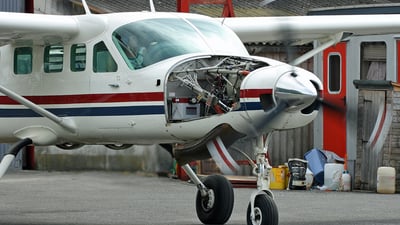
The aircraft was being taxied from dispersal to the holding point for a local flight when the pilot heard two loud bangs from the area of the nose wheel. The pilot contacted ATC and requested them to look for damage. ATC reported that a 'panel' appeared loose, so the pilot returned to dispersal and shut down the engine. Examination by the operator's engineer revealed that the rear support of the nose landing gear (NLG) spring had come away from its rear fuselage mounting point, dislodging the composite fairing below the spring.
Engineering Examination
The NLG spring is attached to the fuselage by a forward support and a rear support, each secured by four bolts. One of the four rear support attachment bolts had failed, leaving the threaded portion in the anchor nut; the unthreaded shank was not recovered. The other three bolts were found loose within the composite fairing. Metallurgical examination showed that bolt No. 4 failed due to bending fatigue, with multiple fatigue origins at one side of the bolt. The remaining three bolts were pulled from their anchor nuts, stripping the threads. Fatigue cracks were also found in the thread roots of bolt No. 1.
All four bolts showed evidence of long-term fretting between the bolt shanks and the casting holes. The bolt holes in the fuselage structure were elongated forward, indicating the NLG had moved forward relative to the aircraft axis. The lower surface of the rear support casting exhibited paint loss and polishing in a fore/aft direction, and the composite fairing showed similar rubbing.
Maintenance History
The aircraft was maintained per the manufacturer's schedule. A required inspection every 200 airframe hours for 'security of attachment of both supports' was last performed 106 hours (375 flights) before the accident. Earlier in the aircraft's life, a bushing migration issue was resolved by polishing the spring and bonding the bushing; it was not determined if this involved removal of the rear support.
Ground Tug and Towing Operations
The aircraft was used for parachuting from a grass airfield and was towed uphill to a hangar using a Hydrau Tug 400, which attached via a webbed strap around the NLG leg with no weak link. The tug was rated for up to 25,000 lbs but could tow heavier aircraft on level surfaces. An AAIB investigator found it easy for an inexperienced operator to introduce a severe 'snatch' when starting movement. No towing force limitations were stated in the aircraft's manuals.
Discussion
The failure of one bolt due to fatigue and the pull-out of the other three resulted in the rear support detaching. The fatigue crack initiated in the thread root due to bending. Long-term fretting and forward elongation of bolt holes suggested forward movement of the NLG spring, possibly from towing over surface irregularities. Fretting and bolt hole wear indicated repeated loading over an extended period.