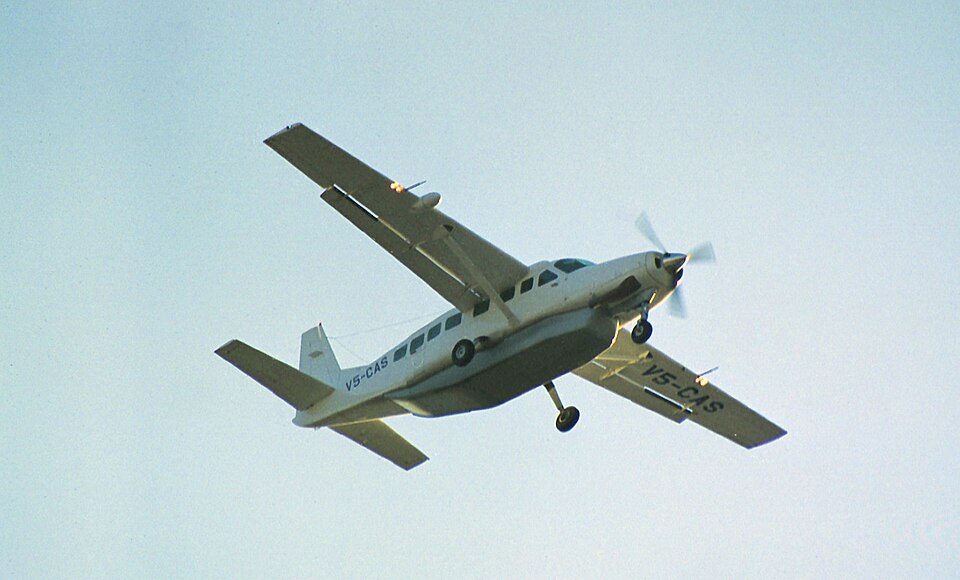
On June 26, 2003, a Cessna 208B Grand Caravan (registration V5-CAS) operated by Comav Aviation was involved in an aviation accident near Rooisand, Namibia in flight. 4 people were killed. Investigators recorded the probable cause as: Controlled flight into terrain caused by the combination of the following factors: - The decision of the pilot to take off from an airfield that was not suitable for night operations, - The absence of a copilot considerably increased the workload of the… This summary draws on records from the Bureau of Aircraft Accidents Archives (B3A).
A single-engine aircraft chartered by International SOS crashed into a hill after departing Rooisand Airstrip at night. All four occupants were killed in the controlled flight into terrain.
Incident Overview and Mission Context A single-engine aircraft, chartered by International SOS, was dispatched to the Rooisand Desert Ranch Aerodrome to transport a medical team and retrieve a patient who had been involved in a car accident. The aircraft arrived at the Rooisand Airstrip approximately 15 minutes before sunset. Because the airfield lacked lighting systems and night conditions were developing, the pilot requested that individuals park their vehicles along the runway with their lights illuminated to provide visual guidance. ## Flight Path and Impact Following takeoff, the aircraft proceeded westbound with a 12-knot tailwind. The intended procedure required the aircraft to circle the runway two or three times to gain sufficient altitude to clear the surrounding hills. Instead, the aircraft turned right toward a hill that stood 258 metres higher than the runway end. After traveling approximately 4.8 kilometres toward the hill, the aircraft banked steeply to the left and turned back toward the southeast. It then descended to a height of 191 metres before striking the slope of the hill. The wreckage was located 17 metres below the hill's summit, and all four occupants were killed. ## Official Probable Cause The investigation determined that the accident was a controlled flight into terrain resulting from a combination of factors. These included the pilot's decision to depart from an airfield unsuitable for night operations, the absence of a copilot which increased the captain's workload, and reduced visibility due to night conditions and a lack of ground reference points. Additionally, the pilot's inability to clearly read instrument panel parameters because he had forgotten his corrective glasses contributed to the outcome.
An X-AIR HAWK ultralight crashed in Chonburi, Thailand, killing the pilot and injuring a passenger. The accident was caused by deteriorated wing fabric and…
A Challenger II Special ultralight aircraft (U-B23) landed off-runway at Pai Airport, Mae Hong Son, on September 17, 2024, due to a gust of wind. No injuries…
The Polish aviation safety authority is investigating a serious incident involving an AT-3R100 aircraft that occurred on September 2, 2024. The investigation…
A SZD-48-3 glider suffered damage when its left wing struck a ground obstacle during a low final approach at EPWK on June 20, 2025. The pilot was uninjured.
A 39-year-old skydiver died after a hard landing near Leszno on May 1, 2026. The PKBWL preliminary report indicates the fatal impact resulted from a late,…
A student pilot crashed an SZD-50-3 Puchacz glider into the airfield fence during a solo training flight on June 6, 2026. The pilot was uninjured, but the…