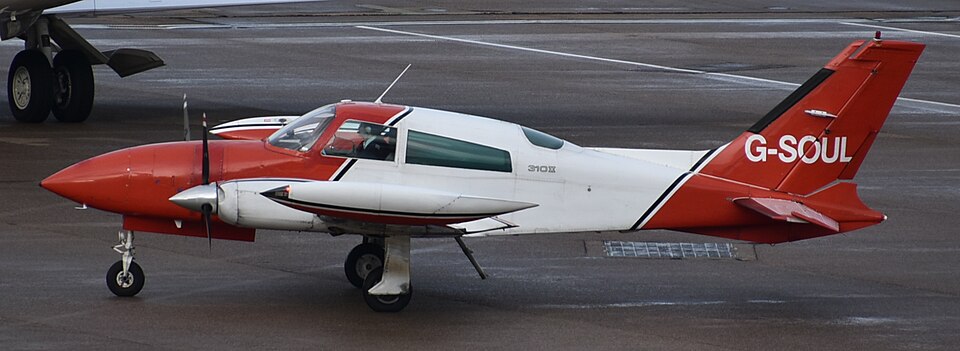
Flight History
The aircraft, a Cessna 310R Seneca registered G-SOUL, was conducting a training flight for a Multi-Engine Piston rating. During a practice short field approach to Runway 21 at Nottingham Tollerton, the aircraft touched down approximately 50 feet beyond the runway designation numbers. The pilot applied gentle braking as the aircraft slowed, but it began to veer to the left and subsequently slewed 270° to the left before coming to rest. The engines were shut down and the two occupants exited normally. Weather conditions were good with no wind and 9 km visibility.
Engineering Investigation
Initial examination revealed that the left main landing gear torque links were disconnected at the centre joint. Tyre marks from the left main wheel were found on the runway, and damage was sustained by the left wheel, tyre, and main landing gear door. Closer inspection showed that the head of the torque link centre hinge bolt had pulled through both the washer and the torque link, allowing the upper and lower torque links to separate. The damaged washer, part number 5045018-1, was sent to the AAIB for examination.
The hexagonal impression of the bolt head was clearly visible where it had forced through the centre of the washer, which had been partly drawn into the bore of the torque link. No evidence of hammering from wheel shimmy was found. The torque links contain plain bushes not designed for axial load; once the bolt head pulled through the washer, the bolt also pulled the bush out of the torque link. Measurements confirmed the washer had the correct outside diameter (3/4-inch) and thickness (0.032-inch) as per the manufacturing drawing, which specified heat treatment for a tensile strength of 125,000 to 150,000 lbf/sq in. Hardness tests showed the damaged washer had a material strength of only 31 tonf/sq in, well below the minimum specification, while a new undamaged washer met the specification. Neither washer bore part number markings, and the origin of the failed washer could not be determined.
Following the incident, the operator installed thicker AN970-3 washers (with the centre hole opened to 5/16-inch) on both main and nose landing gears under a minor modification approved by the CAA. The operator also introduced a specific pre-flight inspection of the torque links. The aircraft manufacturer noted that the 5045018-1 washer had been superseded by a thicker 5045018-2 washer as a product improvement, but the latter was not listed in the current Illustrated Parts Catalogue (IPC). The manufacturer agreed to update the IPC to include the new part number.
Previous Occurrence
An earlier AAIB investigation (Bulletin 12/2001) of a similar incident on 06 June 2001 involving another Cessna 310R found that torque links on the right main landing gear became disconnected due to the apparent omission of the washer. In light of the 2002 incident, it is possible that a washer was installed but pulled through and not recovered. As a result of the previous investigation, the maintenance manual procedure was amended for correct assembly of the torque link centre joint, and Service Bulletin MEB02-12 was issued on 04 November 2002 calling for an inspection of torque link joints.
Conclusions
The accident was caused by the disconnection of the torque link centre joint on the left main landing gear, which allowed the wheel to castor and resulted in a loss of directional control at low speed. A key factor was that the washer under the head of the bolt was of a much lower strength than specified in the manufacturing drawing, which allowed the bolt head to be pulled through the washer under normal landing loads.