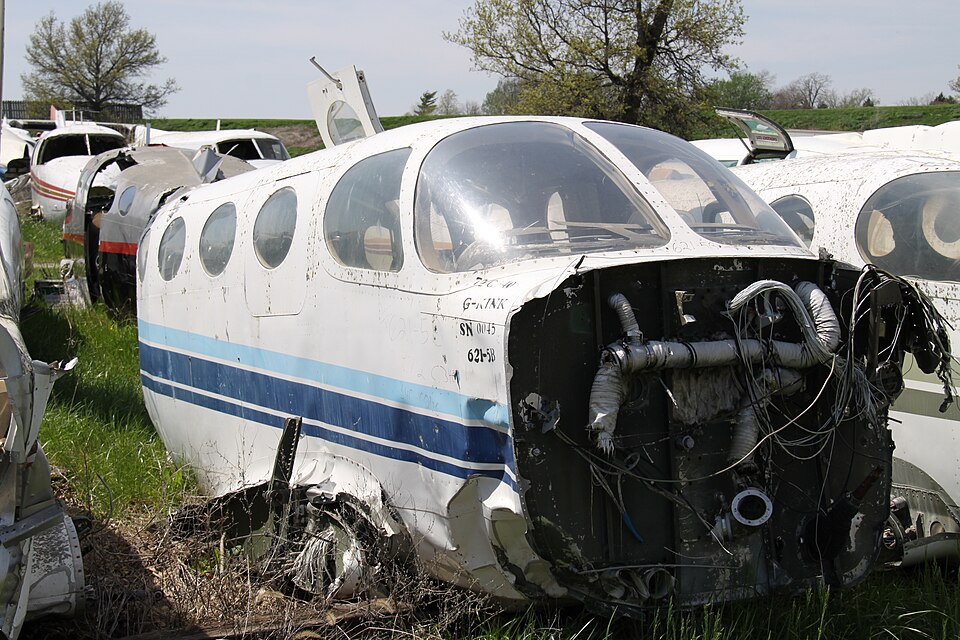
Incident Overview
During a local flight departing Halfpenny Green, a Cessna 340 with registration G-KINK experienced engine failures attributed to fuel starvation. The aircraft was operated by a pilot who had recently resumed flying after a six-month hiatus. Pre-flight checks indicated the left main tank was 30% full and the right main tank was 40% full, while auxiliary wing tanks were full and locker tanks were empty.
Flight Sequence
The aircraft departed in clear weather and climbed to 2,500 feet. The pilot switched fuel selectors from main to auxiliary tanks for cruise, then reverted to main tanks upon returning toward the airfield. At this stage, gauges indicated 50 lb remaining in the left tank and 70 lb in the right, though the pilot knew these gauges over-read. While preparing for landing on Runway 16, both engines faltered after power reduction. The pilot declared an emergency and initially restored power, but the left engine stopped at approximately 300 feet above ground level.
Crash and Aftermath
Unable to feather the propeller, the pilot executed a forced landing into a field of standing crop northwest of the airfield. During maneuvering to avoid farm buildings, the left wingtip struck electricity power lines. The aircraft slid 50 yards, cartwheeled, and came to rest upside down. No fire occurred, and all three occupants remained secured by their seat harnesses. The pilot observed fuel dripping from the valve selector area and successfully switched off the battery and magnetos. He eventually opened the cabin door with difficulty due to the inverted boarding steps.
Investigation Findings
Post-accident examination revealed both propellers were bent rearwards, consistent with windmilling or low power. Fuel was present between the flow divider and injectors of the right engine but absent on the left, confirming fuel starvation as the cause of the left engine stoppage. The maintenance organization noted that Cessna 340 fuel valves require careful operation to ensure correct detent placement. Evidence suggests both engines may have been inadvertently fed from the same main tank. A senior fireman reported the right engine selector was stuck in a position corresponding to the left main tank, supporting the theory that the left tank ran dry first due to shorter fuel lines.