Introduction
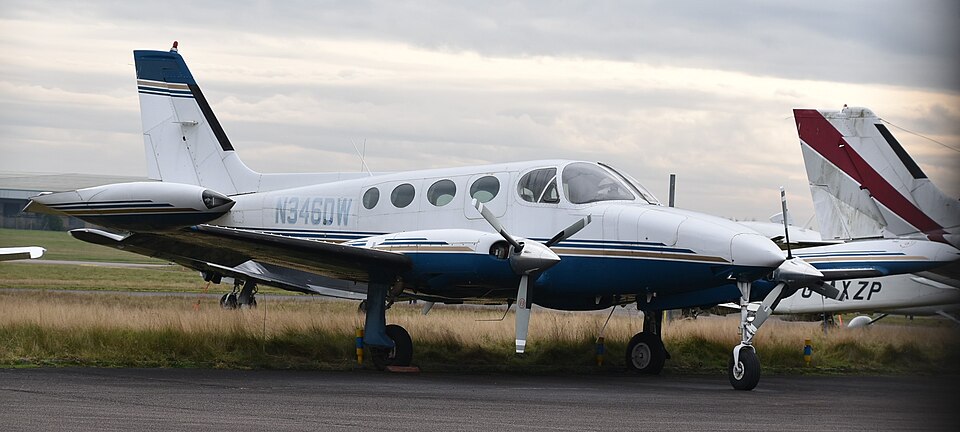
On 15 July 2011, a Cessna 340A aircraft, registration N346DW, experienced a collapse of its right main landing gear during the landing roll at Fairoaks Airport, Surrey. The aircraft sustained damage to the right wingtip, right flap, right propeller, and the right engine was shock-loaded. The pilot, the sole occupant, was not injured.
History of the Flight
The aircraft had recently undergone an annual maintenance inspection and was released to service on 29 June 2011. The accident occurred on the second flight following this inspection. The pilot flew from Dunsfold Aerodrome to Fairoaks Airport, reporting that the landing gear retracted normally after takeoff. On final approach to Runway 24, the pilot selected the landing gear lever to DOWN and observed three green DOWN lights. Touchdown was described as normal by both the pilot and an Aerodrome Flight Information Service Officer (AFISO). As the aircraft settled, the right main landing gear collapsed, causing the right propeller and wingtip to strike the runway. The aircraft veered right onto the grass and came to rest on a heading of 040°M.
Aircraft Information
The Cessna 340A is a pressurised twin-engine aircraft with retractable tricycle landing gear. The landing gear retraction system uses an electric motor and a series of rods, torque-tubes, and bellcranks. The main landing gear is held in the down-and-locked position by a folding side brace, with a downlock link that keeps the side brace over-centre. A microswitch on the downlock link illuminates the green DOWN light when in the over-centre position.
Damage and Component Examination
Inspection revealed that the downlock link had separated from the lower side brace due to fracture of the downlock link adjusting screw. The forward lug on the upper landing gear strut at its attachment to the bellcrank pivot bolt had broken off, and the bellcrank pivot bolt had sheared. The fracture surfaces indicated tensile overload. The microswitch functioned correctly when tested, but its pre-accident alignment could not be determined due to deformation of its mounting bracket.
Maintenance History
The annual inspection included replacement of worn bushes in the right main landing gear bellcrank, requiring disassembly of the downlock link. The maintenance was performed by an unlicensed technician assisted by a licensed engineer and certified by an FAA Inspection Authorisation holder. The recorded downlock breakout forces for both main gears were within Service Manual limits (40 lbf right, 50 lbf left). However, the technician did not perform the full 76-step landing gear rigging procedure, including the 'free-fall' downlock adjustment. The omission of the full procedure was not considered causal to the collapse.
Metallurgical Analysis
Independent metallurgical analysis of the fractured downlock link adjusting screw and bellcrank pivot bolt concluded that both components failed from a single overload event. The adjusting screw showed no pre-existing cracks or material defects, and the pivot bolt failed in single shear without evidence of prior cracking. The adjusting screw material met specifications.
Analysis
Based on the observed damage, it is probable that the downlock link or side brace, or both, were not sufficiently geometrically over-centre at touchdown. In this condition, side load caused the side brace to fold, leading to bending overload of the adjusting screw. Subsequent rotation of the landing gear leg loaded the push-pull tube in tension, resulting in tensile failure of the pivot bolt lug and shear overload of the pivot bolt. The investigation was unable to positively identify the cause of the landing gear collapse.