Synopsis
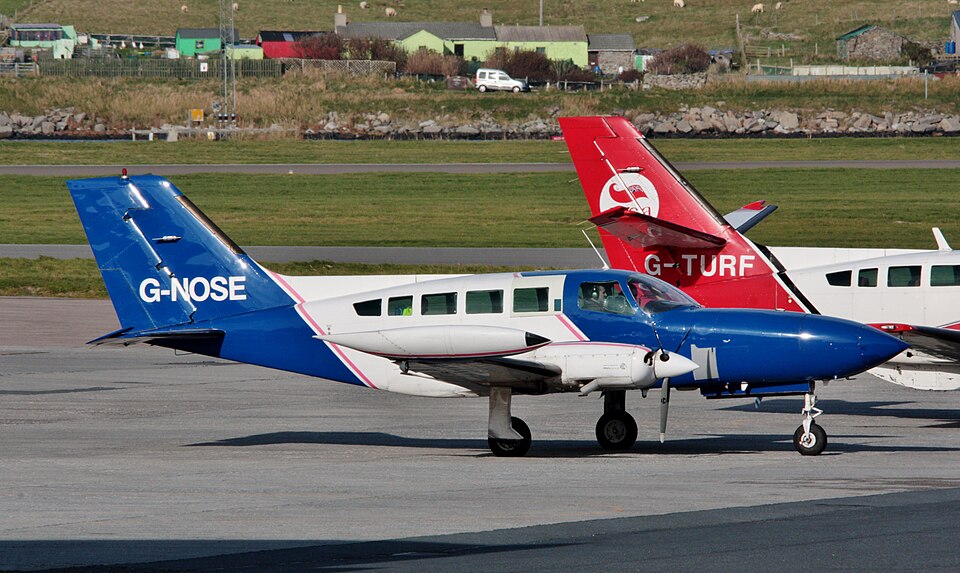
On 14 March 2013, a Cessna 402B, registration G-NOSE, experienced the in-flight departure of its right emergency exit door while descending near Shrivenham, Oxfordshire. The aircraft was engaged in an aerial photography mission. No injuries were reported, and the aircraft sustained minor damage. The door was later recovered from a residential driveway. An investigation could not positively determine why the door released.
History of the Flight
The aircraft was tasked with an aerial photography sortie in the Swindon area. The crew consisted of a pilot, an observer in the left cockpit seat, and an experienced aerial photographer seated next to the right emergency exit in the rear. During pre-flight checks, the pilot verified the security of all doors. After completing the survey, the pilot turned the aircraft to return to East Midlands Airport and initiated a descent from 5,800 ft to 4,000 ft. Airspeed increased from 140 kt to 170 kt. As the aircraft descended through 4,500 ft at 170 kt, the pilot heard a loud bang and felt a distinct change in air pressure. The photographer reported that the right emergency exit had departed. The pilot declared a PAN, slowed the aircraft to 140 kt, and completed an uneventful flight to East Midlands.
Aircraft Information
The right emergency exit door on G-NOSE was a windowed panel approximately 60 cm by 100 cm. It featured a flange on its upper edge that locates in a groove in the upper door aperture. The lower edge was secured by two locking pins passing through lugs, attached by a cable to the door release handle. The pins were prevented from disengaging by two shear pins. Pulling the release handle breaks the shear pins, withdraws the locking pins, and operates an arm that pushes the door outward. A 'tell-tale' wire between the lever arm and the aircraft structure breaks if the lever arm moves from its stowed position.
Investigation
Examination of the recovered door showed no evidence of adverse wear to the attachment flange or securing lugs. An operator inspection confirmed the door release handle had not been operated and was secure in its receptacle. The 'tell-tale' wire was intact, and the shear pins were still in place. The door had not undergone recent maintenance, and inspection of the release mechanism revealed no defects that would allow release without pulling the handle. One possibility considered was that relative movement between the door and the aircraft structure, combined with dynamic flight loads, might have been sufficient to disengage the locking pins, but a positive determination could not be made.