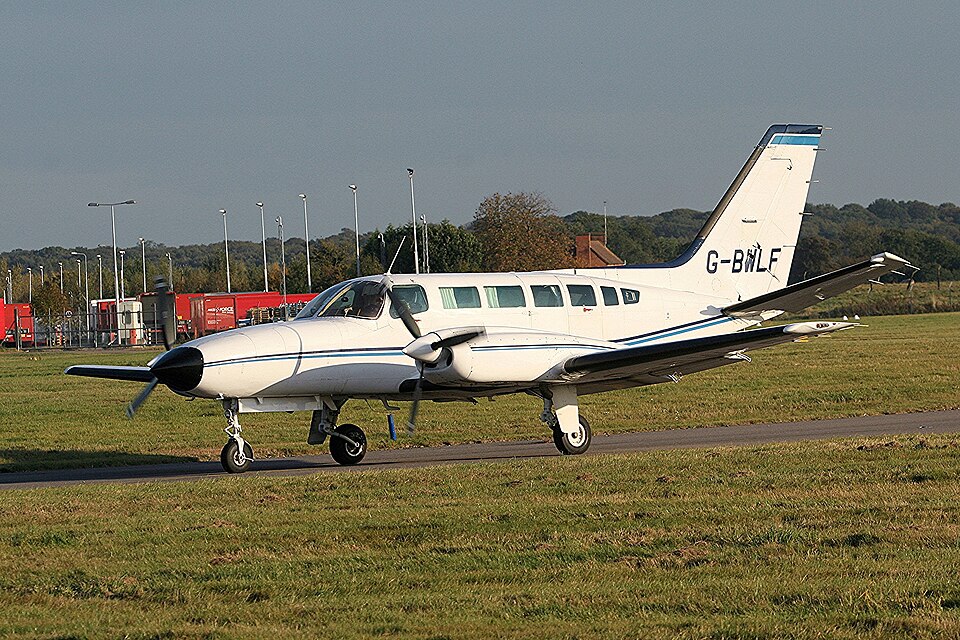
Accident Details
On 4 September 2001 at 1315 hours UTC, a Cessna 404 Titan, registration G-BWLF, was landing at Farnborough Airport, Hampshire, after an aerial survey sortie. The aircraft was crewed by one pilot and carried two passengers; none sustained injuries. Damage was limited to the nose landing gear, forward fuselage, and propellers.
Landing Sequence
The ATIS reported wind from 300° at 15 knots with Runway 07 in use. The pilot elected to approach Runway 25, using a crab technique at 120 knots, slowing to 90 knots at the threshold. Rudder was applied before touchdown to align the aircraft with the centreline. The landing and initial ground roll were normal, but after two to three seconds of nosewheel contact, the nose dropped slightly and began to judder. The pilot initially suspected a deflated nosewheel tyre, but the nose continued dropping until both propellers struck the ground, indicating the nose landing gear (NLG) had collapsed. The pilot maintained directional control on the centreline, stopped the aircraft, informed ATC, and completed shutdown and evacuation.
Post-Landing Observations
External inspection revealed the NLG leg had broken rearwards and to the left side, lying under the nose. The right-hand NLG pivot trunnion lug had fractured, causing the collapse. Minimal additional airframe damage was noted.
Metallurgical Examination
An independent metallurgical report determined that the lug had fractured in bending overload, probably due to excessive side loads. The fracture face contained a low-cycle fatigue crack extending roughly one quarter of the circumference, reaching a maximum depth of 0.036 inches. This crack was not considered large enough to have significantly compromised the lug's strength. However, its presence in an area known to be prone to cracking on Cessna 310, 335, 340, 401, 402, 404, 411, 414, and 421 aircraft was noted as a concern, given the existence of a mandatory Service Bulletin (SB) for inspection.
Service Bulletin Compliance
Cessna Service Bulletin MEB88-5 Revision 2, dated 2 October 2000, requires repetitive inspections using eddy current and fluorescent dye-penetrant methods on trunnion lugs. The inspection threshold is 2,500 hours trunnion total time or 5,000 landings, with repeat intervals of 1,000 landings. The SB specifies two possible lug diameters: 1.19 inches and 1.31 inches; G-BWLF had the smaller size. No cracks are tolerated in the smaller size; for the larger size, a temporary repair (blending out) up to 0.050 inches is permissible if spares are unavailable.
Examination of the aircraft's technical records showed the last inspection had been performed 57 flying hours and 7 months prior to the accident. The metallurgical report concluded that the specified inspections could not guarantee 100% detection of a crack of the depth observed on G-BWLF, and recommended that the manufacturer review the critical crack depth to adjust inspection methods and frequency.
Findings
The AAIB informed both the CAA and the FAA of the findings.