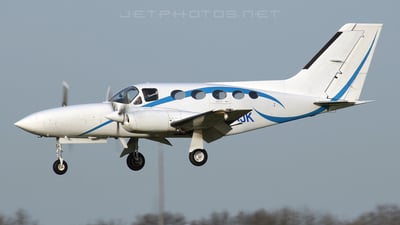
History of the Flight
The aircraft, a Cessna 421C Golden Eagle registered G-HIJK, was conducting a commercial air transport passenger flight. The pilot made a standard visual approach to Runway 26 at Bournemouth Airport, followed by a normal touchdown close to the runway aiming markers and on the centreline. As the nosewheel was lowered, the pilot heard a "whining, rubbing noise" from the nosewheel region and felt a slight nosewheel vibration or shimmy. He continued to decelerate to about 50 kt on the centreline at idle power and without using the brakes, having used about 500 metres of the runway. At this point the vibration increased markedly and the aircraft veered sharply to the left through about 45°.
Despite application of full right rudder and toe brake, the pilot realised that the aircraft was going to leave the paved surface so he applied maximum braking to slow it as much as possible. The aircraft ran onto the grass at an estimated speed of about 10 to 15 kt, collapsing the nose landing gear (NLG) as it did so, before stopping a few metres from the runway edge. After shutting down the aircraft, all the occupants evacuated through the overwing emergency exit without any injury.
Examination and Discussion
The aircraft came to rest on its main landing gear while the nose fuselage and propeller tips had struck the ground. It was recovered to a hangar for examination where it was found that the NLG leg had folded into the retracted position due to overload failure of the downlock mechanism. The nosewheel tyre had completely deflated due to what appeared to be massive wear of the sidewall on the right side. The inner tube had been liberated from the inside and was wrapped around the axle.
G-HIJK was fitted with a sheet metal mudguard attached to the nosewheel fork at the top and at the bottom used a shaped tubular brace which attached to the forks either side of the axle. The mudguard had remained attached at the top but had been buckled with the braces at the bottom broken. On the right side, the broken bracing tube had rotated through almost 180° and become jammed between the fork and the tyre. This was consistent with the pilot’s recollection of a “whining noise” followed by severe vibration and shimmy as the tyre deflated.
There was no immediately apparent reason for the failure of the bracing tube. Circumstantially, it is most likely that it was damaged either during taxiing or ground handling, since the attachments were intact.
Damage
The propellers, nose landing gear, nose bay doors, and radome were damaged. The engines were shock-loaded.