History of the flight
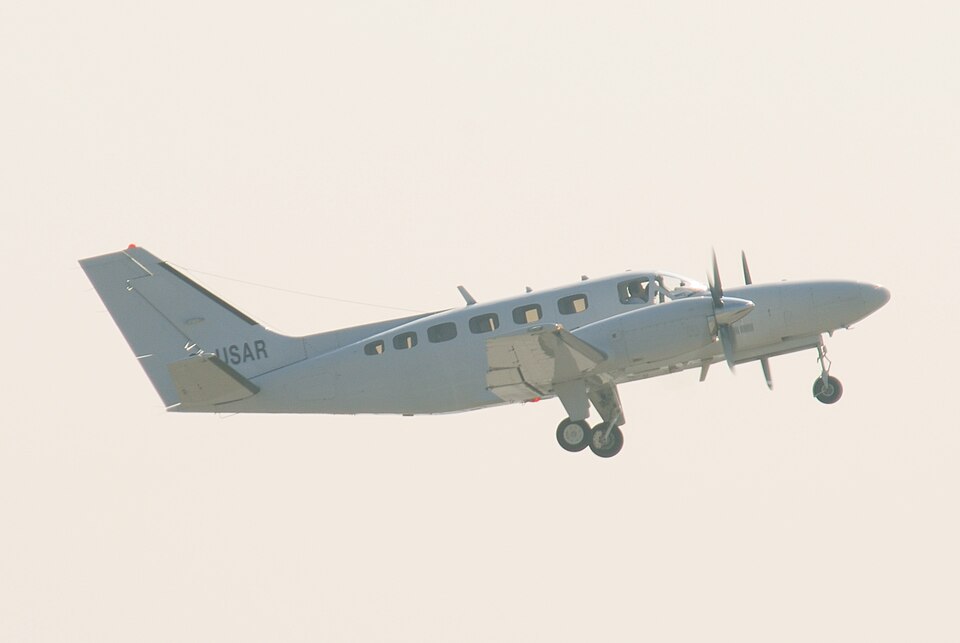
The aircraft, a Cessna 441 Conquest registration G-USAR, operated a private flight from Zurich, Switzerland, to East Midlands Airport. The pilot planned an ILS approach with the autopilot engaged. The aircraft was given radar vectors to intercept the final approach course. The pilot reported that he was flying with the autopilot engaged and maintaining the assigned heading. He noticed that he had inadvertently descended below the assigned altitude of 2,000 ft to 1,800 ft. He disengaged the autopilot to correct the height manually, but while doing so, he went through the localiser. He reported to ATC that he would re-establish on the approach. He then attempted to re-engage the autopilot unsuccessfully. The pilot again reverted to manual flight but became disorientated, and the aircraft went through a series of erratic manoeuvres.
Aircraft and Crew Information
The aircraft was a 1985 Cessna 441 Conquest with two Garrett AiResearch TPE 331-10N-513S turboprop engines. The commander held a Commercial Pilot’s Licence, was 59 years old, and had 14,000 hours total flying experience, including 220 hours on type. The last 90 days included 62 hours, and the last 28 days 38 hours. There was one passenger on board. No injuries to either occupant and no damage to the aircraft were reported.
Weather Conditions
The weather at East Midlands Airport was recorded as: surface wind from 260°M at 25 kt, overcast cloud at 600 ft aal, light rain, visibility 7 km, temperature 2°C, and barometric pressure 1028 mb. Moderate turbulence and light icing were also reported. It was dark.
ATC Interaction
The aircraft was handed over from the radar controller to the aerodrome controller (ADC) at 7 DME. The ADC noticed on his Aerodrome Traffic Monitor that the aircraft was deviating to the right of the localiser course. The pilot reported he would re-establish, and the controller issued a clearance to continue the approach. The controller then observed unusual manoeuvres, and the aircraft appeared to have entered an orbit at 6 DME. The controller asked whether radar vectors were required, but the pilot decided to continue. Several more exaggerated heading changes to the north and south of the final approach course were observed, together with rapid altitude changes. The lowest indicated altitude seen by the controller was 1,100 ft (800 ft aal) at 5 DME. The aircraft was still not established on the localiser, and the ADC instructed the pilot to fly a heading of 180°M and climb to an altitude of 2,500 ft. The pilot complied and was transferred back to the radar controller. A second, successful ILS approach was made.
Pilot's Comments
The pilot reported afterwards that, in hindsight, he should have gone around as soon as he identified a problem with the autopilot. He noted that, in transitioning several times from automatic to manual flight, he had become confused by the attitude presentation and disorientated. The aircraft was fitted with an attitude indicator with a ‘sky pointer’ presentation with which he was unfamiliar. He considered that if he had allowed himself sufficient time to settle into manual flight the problem would not have occurred.