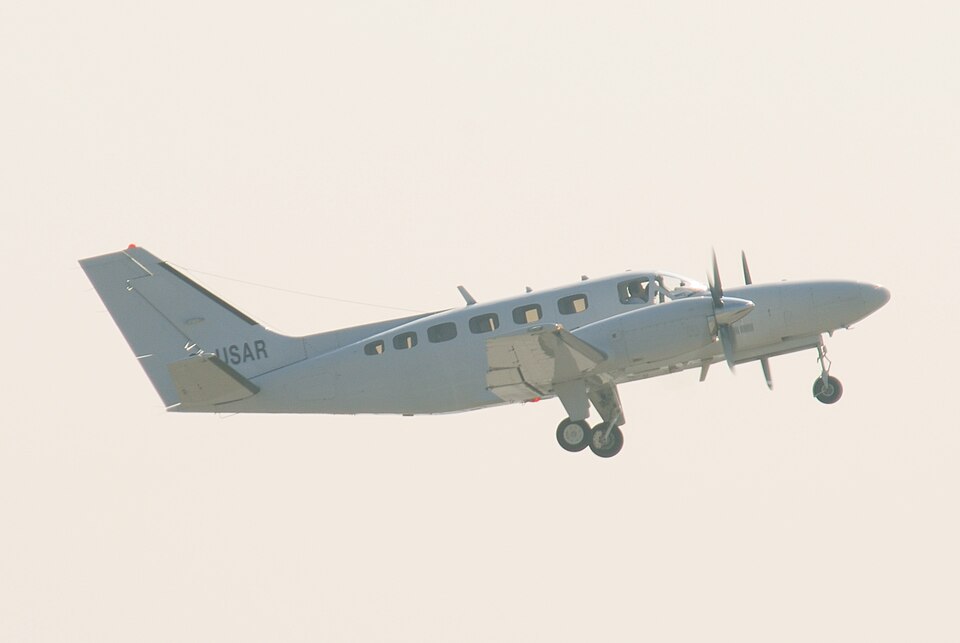
Synopsis
On 25 July 2011, at 0708 hrs, a Cessna 441 Conquest (registration G-USAR) experienced a right main landing gear failure during the landing roll at Doncaster Airport, South Yorkshire. The aircraft was operating as a private flight with one pilot and two passengers on board. No injuries were reported among the crew or passengers. The aircraft sustained damage to the right landing gear, wing, flaps, and the engine was shock-loaded.
History of the Flight
After a normal landing, the pilot selected reverse pitch on the propellers to slow the aircraft. As the aircraft decelerated, a vibration from the right main landing gear became apparent. The pilot initially believed it was caused by wheel shimmy, but after a few seconds the trailing arm failed, causing the right wing to contact the ground. The pilot heard a loud bang and the right wing dropped. The aircraft veered to the right and came to rest on the grass on the right side of the runway. The pilot shut down both engines after the aircraft rotated to the right. After the aircraft came to a halt, the pilot left through the normal exit. He was uninjured.
Examination and Investigation
The AAIB field investigation examined the aircraft and found that the right main landing gear trailing arm had failed between the lower shock absorber bracket and the hinge point. After recovery, the trailing arm assembly was removed for detailed examination. The section of the trailing arm that remained attached to the landing gear leg had been damaged by contact with the runway surface after the failure, destroying any features that may have indicated the initial failure mode. The section attached to the wheel was examined; no corrosion was identified on the external surface or inner bore. The fracture surface on this section had two distinct features: a large area showing characteristics of an overload fracture in bending, and a flat face perpendicular to the axis of the trailing arm. Both optical and Scanning Electron Microscope (SEM) examination of this area failed to identify any features that could be associated with the initiation of the failure. The examination confirmed that the fracture surface had been abraded by runway contact, removing features that may have indicated the initial failure mode.
Maintenance History
The maintenance records confirmed that the aircraft had been maintained in accordance with the manufacturer’s approved maintenance programme and satisfied all regulatory requirements. The records showed that the aircraft underwent a scheduled maintenance input in May 2011, which included inspections of the main landing gear for defects and condition. No defects were identified with the trailing arms of the main landing gear during this input.
Conclusion
The reason for the failure of the trailing arm could not be identified due to damage of the fracture surfaces caused by contact with the runway.