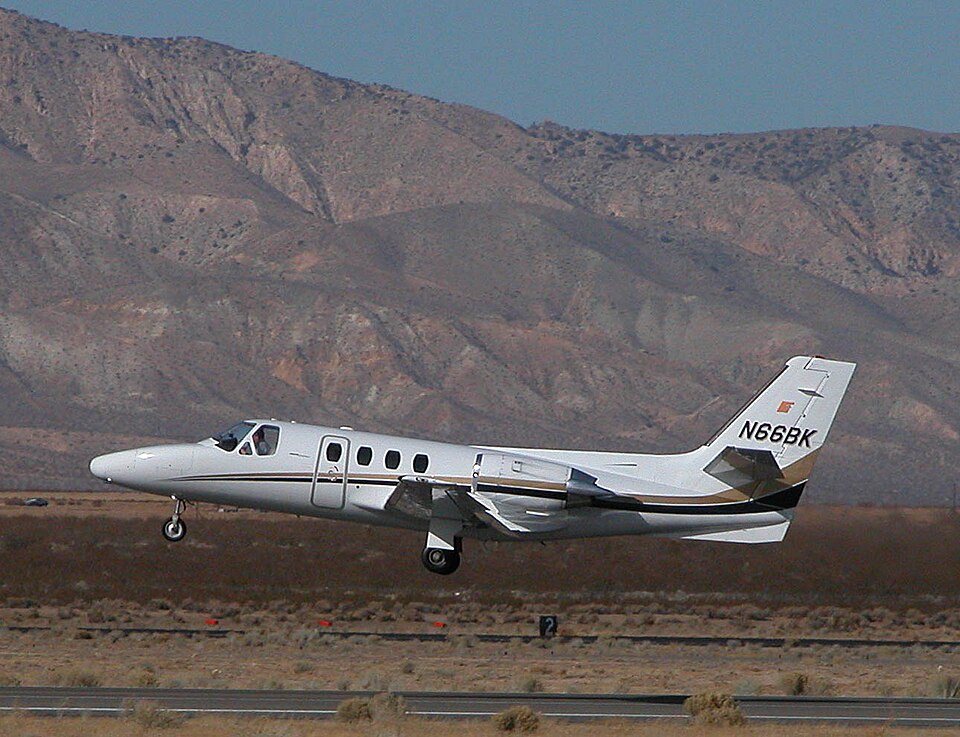
Flight Sequence
A business jet airplane, piloted by an instrument-rated pilot with a pilot-rated passenger and five passengers, departed on a cross-country flight. During takeoff, the airplane entered clouds while executing a climbing right turn and then began to descend. Air traffic control (ATC) asked the pilot to confirm altitude and heading; the pilot did not respond initially but acknowledged after a second query. The airplane subsequently made a climbing right turn followed by a left turn. After multiple ATC attempts to contact the pilot, the airplane entered a rapid descending left turn and impacted a shallow reservoir at a high rate of speed.
Investigation Findings
Postaccident examination of the recovered wreckage and both engines revealed no evidence of any preimpact mechanical malfunctions or failures that would have precluded normal operation. Flight track data showed that after takeoff, the airplane entered the clouds and performed a series of heading changes along with several climbs and descents before entering a steep, descending left turn. According to a National Transportation Safety Board (NTSB) performance study, accelerations associated with the airplane's increasing airspeed were likely perceived by the pilot as the airplane pitching up, although it was in a continuous descent. This type of maneuvering was consistent with the onset of a type of spatial disorientation known as somatogravic illusion.
Pilot and Medical Factors
The pilot likely did not effectively use his instrumentation during takeoff and climb due to experiencing spatial disorientation. As a result, he likely experienced a high workload managing the flight profile, which would have had a further adverse effect on his performance. The airplane entered a high acceleration, unusual attitude, descending left turn from which the pilot was not able to recover. The pilot and the pilot-rated passenger did not report any medication use or medical conditions to the Federal Aviation Administration on their recent medical certification examinations. Postaccident specimens were insufficient to evaluate the presence of any natural disease during autopsy, but given the circumstances, it is unlikely that medical conditions were factors. Low levels of ethanol were detected in the pilot's muscle tissue and the pilot-rated passenger's muscle and kidney tissue; n-butanol was also detected in the pilot's muscle tissue. Given the length of time to recover the airplane occupants from the water and the circumstances, it is reasonable that some or all of the identified ethanol came from sources other than ingestion, and thus did not contribute to the accident.