Accident Details
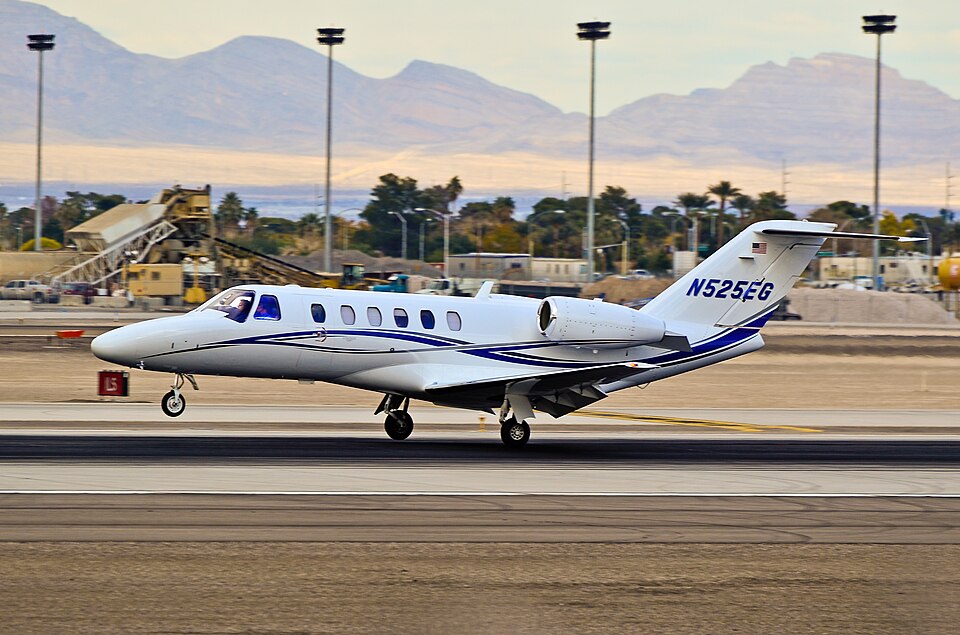
On November 30, 2018, at approximately 1028 central standard time, a Cessna 525A (Citation) airplane, registration N525EG, was destroyed in an accident near Memphis, Indiana. The pilot and two passengers were fatally injured. The flight operated under Title 14 Code of Federal Regulations Part 91 as a business trip, originating from Clark Regional Airport (JVY) in Jeffersonville, Indiana, with Chicago Midway International Airport (MDW), Illinois, as its destination.
Flight Sequence
The airplane was equipped with automatic dependent surveillance–broadcast (ADS-B) and a cockpit voice recorder (CVR). It lacked a flight data recorder, which was not required. Before departure, the pilot conducted checklists and briefed that after takeoff decision speed, an emergency would be handled as an inflight emergency. The controller cleared the flight to climb to 3,000 ft and proceed direct to STREP. Departing runway 36 at JVY at 1024:36 in instrument meteorological conditions, the pilot set maximum cruise thrust and engaged the yaw damper and engine sync. The autopilot was activated at 1025:22. At 1025:39, the controller cleared the flight to 10,000 ft. The airplane passed 3,000 ft at about 1026, with airspeed between 230 and 240 kts.
Cockpit Voice Recorder
At 1026:29, the pilot was instructed to contact Indianapolis Air Route Traffic Control Center and acknowledged. At 1026:38, while resuming the checklist, the pilot noted that pressurization and anti-ice systems were not required. At 1026:48, the autopilot disconnected, followed by the pilot's exclamation of "whooooaaaaah." Over the next 8 seconds, six "bank angle" alerts from the enhanced ground proximity warning system (EGPWS) occurred. At 1027:04, an overspeed warning sounded. The pilot transmitted a mayday at 1027:11, reporting an emergency descent and inability to regain control. At 1027:16, the EGPWS announced "terrain terrain," and impact occurred approximately 4 seconds later.
Performance Study
According to the NTSB performance study, at 1026:45 the airplane began banking left at about 5° per second. For 12 seconds after roll onset, the airplane continued climbing without power reduction. At 1026:57, the airplane reached a maximum altitude of about 6,100 ft mean sea level, then descended at over 11,000 ft per minute. Bank angle reached 70° left wing down at 1026:58, and near 90° at 1027:05. At the final ADS-B data point (1027:18), the airplane was at about 1,000 ft mean sea level, airspeed around 380 kts, and in a 53° left bank. The entire event from initial roll to impact lasted about 35 seconds.
Probable Cause
The National Transportation Safety Board determined the probable cause to be the asymmetric deployment of the left wing load alleviation system for undetermined reasons, which resulted in an inflight upset from which the pilot was not able to recover.