Background
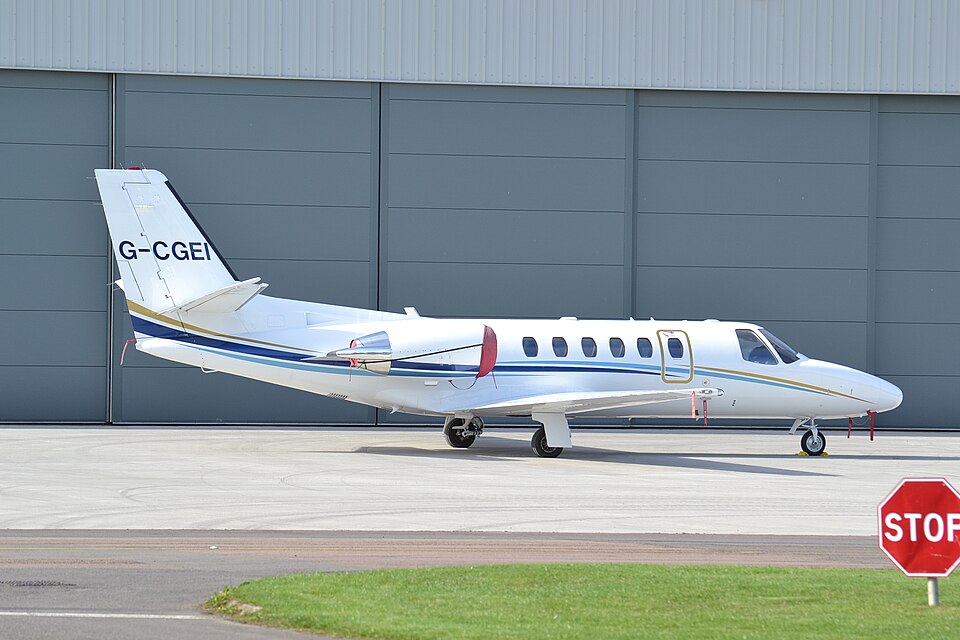
The aircraft, a Cessna 550 Citation Bravo registered G-CGEI, was manufactured in 2000 and powered by two Pratt & Whitney Canada PW530A turbofan engines. On 30 April 2012, it was being flown as a private flight from Biggin Hill to Bournemouth Airport after undergoing interior refurbishment and repainting.
History of the Flight
During the approach to land on Runway 08 at Bournemouth Airport, the nose landing gear (NLG) failed to extend using either the normal or emergency extension systems. The aircraft landed with the nose gear retracted, resulting in damage to the lower forward fuselage and the NLG doors. The three crew members, who were the only occupants, were uninjured and exited the aircraft through the main cabin door.
Investigation
After the aircraft was jacked and the emergency landing gear extension system depressurised, the NLG doors were opened manually. Considerable force was required due to the damage sustained during the landing. Once the doors were open, the NLG extended freely under gravity.
Hydraulic fluid was found on the underside of the right wing and on the lower rear fuselage. This was traced to a leak from the right main landing gear (MLG) uplock union. Subsequent landing gear function checks, with the NLG doors disconnected, confirmed that the landing gear would extend normally using both the normal and emergency systems, despite the leak.
The caster angle of the NLG was measured as 4°30'; the aircraft maintenance manual specified a limit of 4° +/- 15'. It was not possible to measure the rigging of the NLG doors due to the damage they had sustained.
A review of the maintenance work carried out at Biggin Hill confirmed that no work had been performed on the NLG doors. They had been painted in the closed position, and there had been no reported problems with the landing gear prior to the flight to Biggin Hill or during the subsequent departure for Gloucester.
Findings
- The nose landing gear failed to extend during approach.
- The aircraft landed with the nose gear retracted, causing damage to the lower forward fuselage and NLG doors.
- A hydraulic leak was present from the right MLG uplock union, but functional tests showed the landing gear could extend normally.
- The NLG caster angle was slightly outside the specified limit but within an acceptable range.
- No maintenance had been performed on the NLG doors at Biggin Hill.
Analysis
In view of the lack of reported problems with the landing gear prior to the incident, the satisfactory results of the extension system functional tests, and the inability to carry out rigging checks of the NLG doors due to damage, there was insufficient evidence to identify the cause for the NLG failing to extend.