Incident Overview
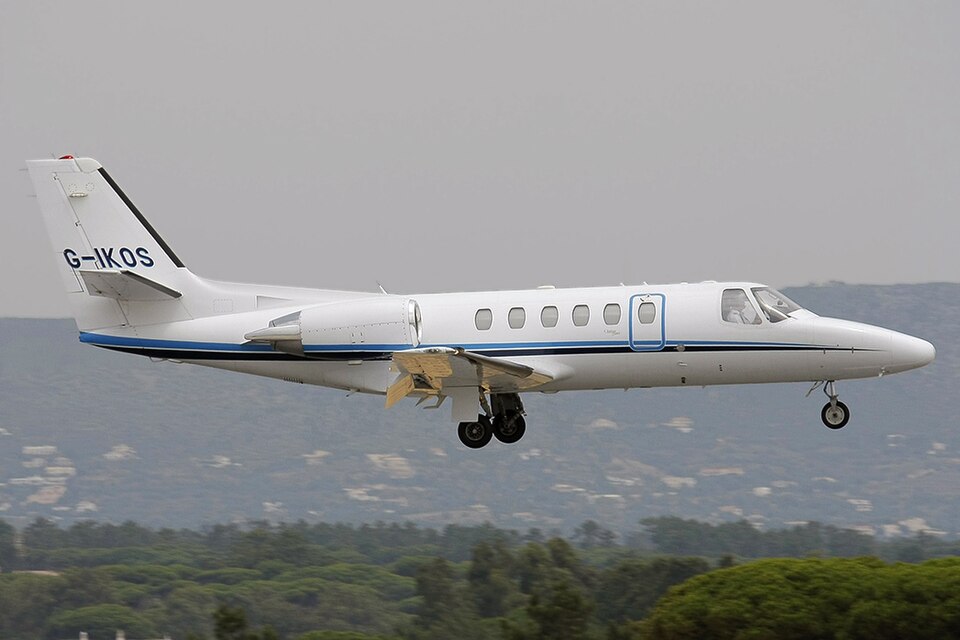
On 5 February 2008, a Cessna 550 Citation Bravo, registration G-IKOS, was on a private flight from Nice to Biggin Hill Airport, Kent. The aircraft, equipped with two Pratt & Whitney Canada PW530A turbofan engines, was on a fully coupled approach to Runway 21 for a manual night landing. The reported surface wind was 230°/15 kt.
Windshear Encounter
At approximately two miles from the runway threshold, the aircraft encountered severe windshear. The EFIS speed tape indicated a trend below 100 kt, and the autopilot pitched up to maintain the glideslope. The aircraft appeared to stall with a right-wing drop. The PF recovered by lowering the nose and increasing power. The maximum roll attitude recorded during the event was 6.1° right-wing down, and the minimum vertical acceleration was 0.498g. During recovery, a transient acceleration of 1.74g was recorded.
Landing and Bouncing
The approach was continued. On landing, the initial touchdown was flat, and the aircraft entered a series of porpoising bounces, reaching heights of 10 to 15 ft. The first officer called for a go-around during the second bounce, but the commander decided to continue. The aircraft was stopped within the runway length and taxied normally. The bounced landing had an initial vertical acceleration of 1.6g, reducing to 0.53g, then increasing to 2.1g.
Crew Reports
The commander submitted an accident report, considering the windshear an isolated phenomenon and stating he maintained control and the runway centreline. He assessed the cause as a combination of "wind, touchdown speed and bad light conditions at the moment of landing." The first officer noted that Vref +10 kt was being flown and at least 15 kt was lost in the windshear. He reported that on landing, a series of 's' porpoises occurred.
Cockpit Voice Recorder
The CVR captured the first officer calling "speed speed speed speed" during the windshear. The commander responded, "wow, we have to report that, severe windshear." A GPWS callout "Glideslope Glideslope" followed by "minimums" was heard. The first officer commented "you can't fly minimum approach in this weather," and the commander replied "no-no way are you crazy with the windshear." Five seconds after touchdown, the first officer called for a go-around; the commander responded "why." During rollout, the commander asked if the runway was bumpy; the first officer said "no there was no flare."
Flight Data Recorder
The FDR recorded IAS once per second. Initially stable at 117 kt, one second later speed dropped to 105 kt. Pitch attitude decreased to 7° nose down over four seconds, with IAS increasing to 133 kt. The IAS remained unstable for the remainder of the approach, varying between 111 kt and 139 kt.
Operator Safety Action
Following the incident, the operator introduced stabilized approach criteria requiring crews to go-around if not stable by 500 ft agl or if the approach becomes destabilized below 500 ft agl.