Incident Overview
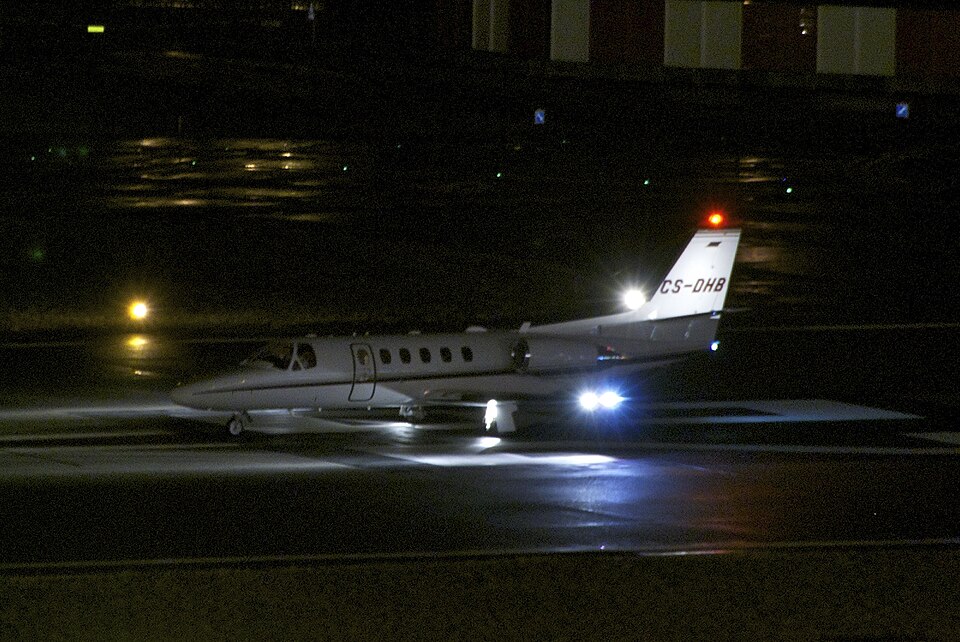
On 27 January 2003, a Cessna 550 Citation II (registration CS-DHB) operating a public transport positioning flight from Paris Le Bourget Airport to Aberdeen Airport, Scotland, experienced a bounced landing during an ILS approach to Runway 34. The aircraft, crewed by two pilots with no passengers, sustained damage to the nose landing gear. The commander reported a downdraft just before touchdown, leading to intervention. The aircraft touched down five times, with the final bounce recording a nose-down pitch attitude of -5.2° and a vertical load of 2.7 g. A go-around was initiated after the final touchdown.
Weather and Approach
At the time of the approach, the surface wind at Aberdeen was from 270° at 22 kt gusting 32 kt, with a crosswind component near the company limit of 24 kt. The recorded meteorological conditions at 1950 hrs showed wind from 260° at 19 kt gusting 31 kt, varying between 240° and 300°. The aircraft was flown by the co-pilot, who disconnected the autopilot at 250 ft above aerodrome level (aal) and held a left wing low sideslip from about 150 ft aal.
Bounced Landing Sequence
Flight data recorder (FDR) data showed that the aircraft touched down five times. The first touchdown occurred at 124 kt with a pitch attitude of -0.7°, recording 1.6 g. Subsequent touchdowns at two-second intervals increased in severity: the second at 118 kt with -2.5° pitch and 1.7 g; the third at 114 kt with -2.3° pitch and 2.0 g; the fourth at 110 kt with -4.0° pitch and 2.67 g; and the fifth at 108 kt with -5.2° pitch and 2.7 g. Engine power increased from 30% N1 during the fourth touchdown, and after the fifth, the aircraft left the runway at a minimum recorded speed of 105 kt, then pitched up, accelerated, and climbed away.
Damage and Diversion
During the attempted landing, the nosewheel rim disintegrated, causing numerous small dents in the fuselage skin aft of the nose landing gear and minor damage to the right flap. The crew retracted the landing gear after the go-around and were informed of debris on the runway. After holding for 45 minutes and consulting with company personnel via satellite telephone, the crew decided to divert to Glasgow Airport, where wind conditions were more favourable (270° at 16 kt). At Glasgow, a low pass confirmed all landing gear appeared down. The commander performed a normal touchdown at 2153 hrs; however, lowering the nose landing gear revealed damage, and the aircraft stopped on the runway centreline with fire service attendance.
Engineering Findings
Examination after the incident showed that the nosewheel rim was missing, with the deflated tyre held in the fork of the nose landing gear strut. The wheel debris recovered from Aberdeen consisted of about 17 pieces of the left and right rims, bearing no signs of runway abrasion but distorted prior to separation. No pre-existing cracks or defects were found. The tyre was intact and had deflated due to rim failure. The wheel manufacturer's analysis also concluded no pre-existing defects. No structural damage to the nose landing gear or its attachments was found.