Introduction
On 7 June 2010, a Cessna Citation CJ1+ (registration N646VP) operated by a private pilot with one passenger sustained significant damage during a rejected takeoff at Leeds Bradford Airport. The aircraft, powered by two Williams FJ44 turbofan engines, departed the runway and came to rest after hitting a fence. Both occupants were unhurt.
History of the Flight
The pilot planned a private flight to Cannes Mandelieu Airport. The aircraft was loaded with 3,320 lb of fuel. Before departure, the owner, a licensed helicopter pilot, joined the pilot in the cockpit. At 1634 hrs, they received taxi clearance. The wind was from the north at 5 kt, visibility 30 km, few clouds at 700 ft, temperature 15°C, QNH 1008 mb. At 1641 hrs, the aircraft was cleared to line up on Runway 14, and the pilot applied the parking brake. At 1644 hrs, takeoff was cleared. The pilot advanced throttles to takeoff detent and confirmed FADEC indicator and engine N1 indications. At 80 kt, airspeed indications agreed. As speed increased toward V1, the pilot sensed less acceleration than expected and said "something's not quite right." Deciding the aircraft would not achieve V1, he rejected the takeoff: closed throttles, applied maximum braking, extended speed brakes, and transmitted "abort; abort; abort." The aerodrome controller asked if assistance was needed; the pilot replied "stand by." After throttle closure, the aircraft pulled left. At 1645:39 hrs, the controller reported a fire on the right side. The aircraft drifted left, responded slowly to right rudder, then corrected toward centerline but brakes became ineffective. As it neared the runway end, the pilot attempted to pull the emergency brake handle but accidentally pulled the auxiliary gear control handle. When he pulled the emergency brake handle, it had no effect. The aircraft ran off the runway to the right, down a slope. The owner moved throttles to off. The right main landing gear collapsed, nose landing gear detached. Both occupants exited through the left door; the pilot returned briefly to turn off electrics.
Witness Information
The pilot reported acceleration appeared normal to 80 kt but felt insufficient thereafter. He judged there was sufficient runway to stop. The owner noticed nothing unusual until the reject and also believed there was enough runway. He stated brakes seemed ineffective and, when overrun was imminent, moved throttles to off. The aerodrome controller thought the aircraft seemed slightly slow; after the abort transmission, he saw flames burst from the right side but could not identify the source. An airside safety coordinator saw the aircraft slow initially, but about two seconds after the abort transmission, flames emerged from the right main landing gear.
Braking System Description
The CJ1+ has a hydraulically-powered braking system with an electrically-signalled anti-skid system. An electric pump pressurises the brake accumulator to over 1,300 psi and reactivates below 900 psi. Pressure is modulated by master cylinders on each rudder pedal. The parking brake traps applied pressure when a handle under the left instrument panel is pulled. If pulled with no foot pressure, no pressure is trapped; any subsequent footbrake pressure will be trapped and maintained until the lever is returned to off. With full pressure, the parking brake can lock wheels even against full engine power. The emergency brakes are powered by a nitrogen bottle; actuation of the emergency lowering handle supplies gas to blow down gear. Further gas can be used for emergency brake applications, without asymmetric braking or anti-skid.
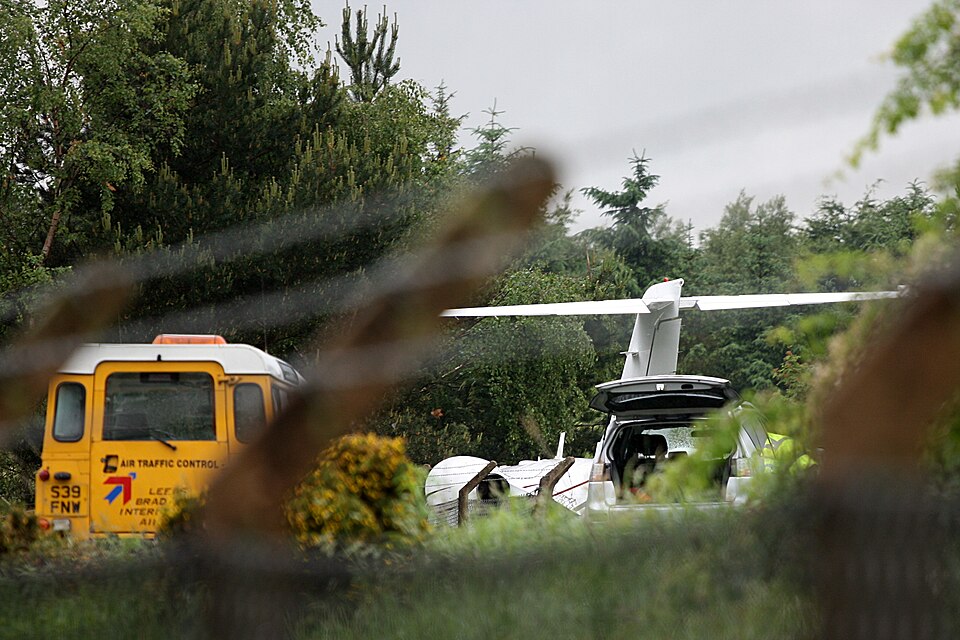
Examination of the Aircraft and Accident Site
The overrun area was a grass slope descending at about 10 degrees. First tyre marks appeared as the aircraft left the paved surface at the extreme right. Three tyre marks in the grass showed minimal yaw and no sign of braking (grass rolled flat). After 83 metres, the aircraft encountered a perimeter road; the right wheel struck firmly, causing metallic scrapes. The aircraft slewed right and struck a fence of concrete posts with chainlink and barbed wire, demolishing a section before coming to rest against small trees. Debris from the right brake, including friction pad material, was found on the runway near Taxiway 'D'. Further parts recovered near the runway end. Cockpit photographs showed throttles in off detent, flap selector at 15°, and parking brake handle stowed (parking brake off). Recovery crew found the emergency gear handle pulled, accumulator charge low, and hydraulic reservoir nearly empty.