Accident Overview
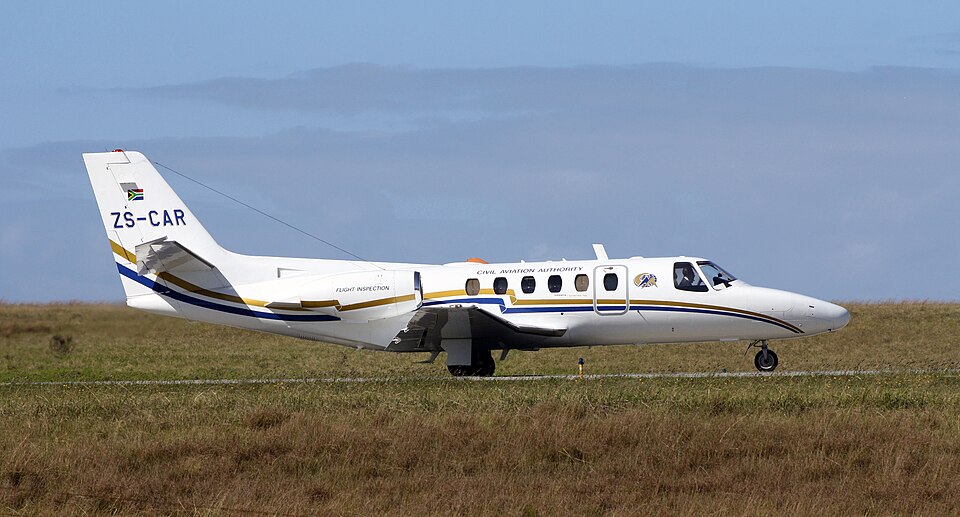
A Cessna S550 Citation S/II operated by the South African Civil Aviation Authority crashed into the Outeniqua mountains near the town of Friemersheim. The three occupants were killed and the aircraft was destroyed.
Flight Details
The aircraft departed Port Elizabeth Airport (FAPE) on a positioning flight to George Airport (FAGG). On approach to FAGG, the crew requested to conduct a calibration flight for the very high frequency omnidirectional range (VOR) beacon at FAGG. Inclement weather prevented clearance for VOR calibration, so the crew decided to land and refuel before calibrating the Instrument Landing System (ILS) on runway 11.
The crew requested take-off from runway 11 with an early right turn to intercept radial 250°, a 17 nautical mile (nm) DME arc to radial 330° at 3000 feet climbing to 4000 feet. Air traffic control (ATC) granted this request.
Accident Sequence
At 10:42, radar data showed the aircraft taking off from runway 11 and making a right-hand turn to intercept radial 250° using the George VOR (GRV VOR), climbing to 3000 feet. Once it reached 17 nm on the DME from the GRV VOR, it began a right-hand turn to intercept radial 330° while maintaining the 17 nm DME arc.
At 10:46, ATC at FAGG advised the crew that they were exiting controlled airspace and should broadcast on the special rules frequency. The crew acknowledged, and no further communication occurred. Secondary surveillance radar continued tracking.
At 10:50, radar indicated the aircraft crossing radial 310° and climbing from 3000 to 3900 feet. After leveling off at 3900 feet, a rapid descent began, losing 1500 feet in about 9 seconds. Three seconds before impact, the aircraft pitched up and struck a ridge at 2192 feet. The aircraft was destroyed, and all three occupants were killed.
Official Findings
The investigation's probable cause was that the crew lost control of the aircraft, leading to significant altitude loss; during recovery, the aircraft collided with the mountain. Contributing factors included low clouds at about 1500 feet above ground obscuring mountain tops, the crew's inability to recover from an unusual attitude, lack of supervision and disregard of regulations by the operator, an overbanked steep dive maneuver that prevented altitude gain, and lack of upset prevention and recovery training.