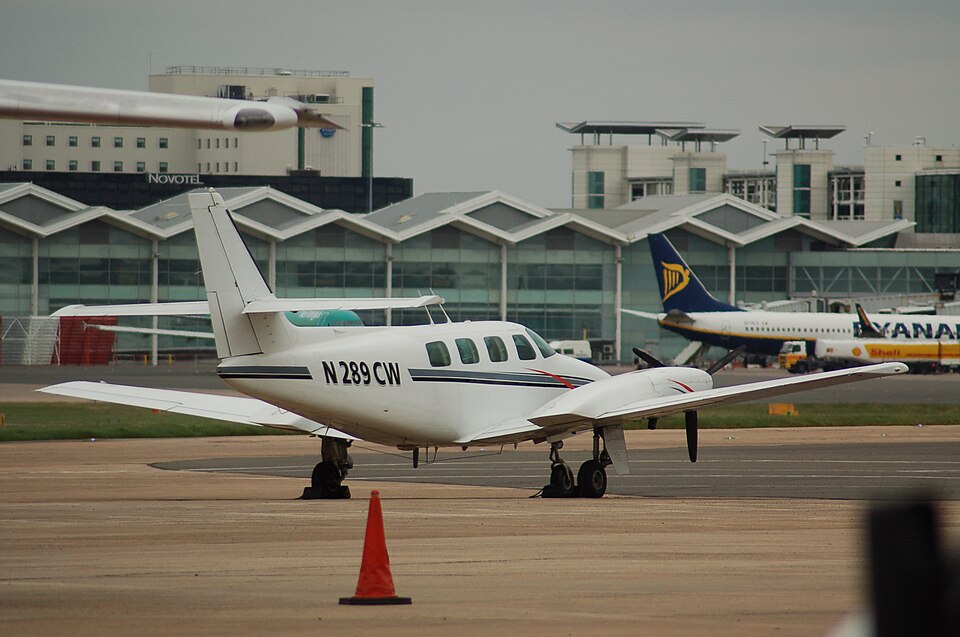
History of the Flight
The aircraft departed Dinan, France, on a VFR flight to Jersey, Channel Islands. It joined the circuit on right base for Runway 09 at Jersey Airport. The aircraft turned onto the runway heading, slightly left of the centreline, and commenced a descent and a left turn. The descent continued to 100 ft. The pilot made a short radio transmission during the turn, after which the aircraft's altitude increased rapidly to 600 ft before descending and disappearing from radar. The aircraft probably stalled in the final pull-up manoeuvre, leading to loss of control and impact with the sea.
Weather Conditions
On the morning of the accident, Jersey Airport had been experiencing fog, which later cleared at the airport but remained extensive over the surrounding sea area, estimated from the surface to a height of 500 ft. A Trislander pilot reported VMC on top of the fog with a clearly defined horizon and the runway visible. The ATIS at 0850 hrs reported visibility 6 km, fog in the vicinity, and surface wind variable at 03 kt.
Radar and Radio Data
Radar returns from Les Platons, Jersey Airport, and Guernsey Airport, along with radio transmissions, were recorded. The aircraft was first identified at 0846 hrs at 2,600 ft. It descended to between 1,300 ft and 1,500 ft as it tracked towards Runway 09 at a groundspeed of approximately 150 kt. At 3 nm from the extended centreline, it descended to 1,100 ft before making a right turn onto final approach. The aircraft passed the extended centreline at 0911 hrs at 600 ft and descended to 100 ft, about 4 nm from the runway threshold, slightly left of the centreline. It then commenced a left turn, during which the pilot transmitted an apology, and continued at 100 ft with groundspeed decaying from 150 kt to 100 kt. After turning through 180°, it climbed rapidly to 600 ft at a rate of 4,000 fpm, then descended similarly below radar coverage.
Wreckage and Recovery
Floating debris, including lightweight plastic, wood, fabric items, and personal effects, was recovered from the sea. Two aluminium honeycomb panels from the upper wing surfaces showed distortion and overload in tension and shear. Cabin trim items were fragmented and distorted. A small black plastic knob from the co-pilot's attitude indicator was found. The position of flaps and landing gear could not be determined. No further wreckage was found on the surface or seabed, likely due to tidal currents.
Aircraft Information
N289CW was a Cessna T303 Crusader, an all-metal twin-engine monoplane with retractable tricycle landing gear. It was built in 1982 and estimated to have accumulated 6,000 flying hours at the time of the accident. The pilot held an FAA Private Pilot's Licence and had 524 hours total flying experience, with 319 hours on type. The aircraft's estimated weight was 4,642 lbs with a forward CG, resulting in stall speeds of 55 kt with full flap, 57 kt with 10° flap, and 63 kt with flaps up.