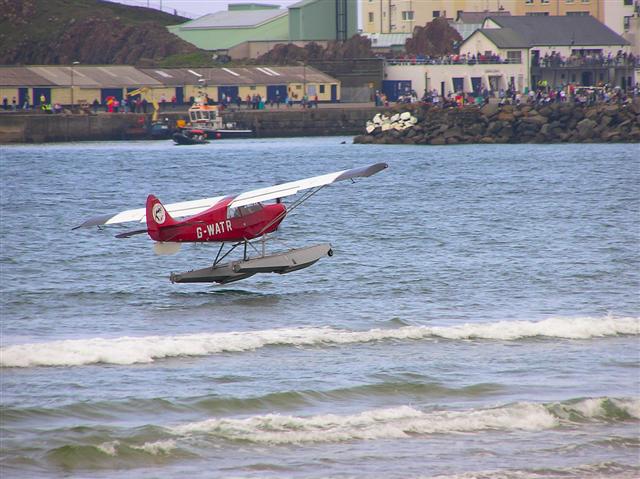
Incident Overview
On 7 August 2013, a Christen A-1 Husky amphibian aircraft, registration G-WATR, was conducting a training flight over Loch Awe, Argyll and Bute. The aircraft was being used to prepare a pilot for renewal of his Single-Engine Piston (Land) rating. The instructor and student were uninjured during the accident, but the aircraft sustained damage to its cowlings, forward fuselage, floats, landing gear, and wings, as well as water immersion.
Flight History
The flight began with a water takeoff from Loch Earn. After refueling at Oban Aerodrome, the aircraft performed three touch-and-go landings and one practice engine failure exercise on the asphalt runway. The crew then proceeded east for upper airwork, where the student practiced stall recoveries with both landing gear extended and retracted. At approximately 2,500 ft amsl over Loch Awe, the instructor initiated a Practice Forced Landing (PFL). Due to heavy woodland terrain, the instructor suggested using a stretch of water parallel to the western shore as an imaginary airstrip. The landing gear remained extended, and although both pilots initially expected to climb away from around 500 ft, the instructor decided to continue for a water landing.
Accident Sequence
During the water landing, the rear wheels and floats contacted the water first, causing rapid deceleration. When the front wheels touched, the aircraft pitched onto its nose and inverted, with floats submerged and tail above water. Both pilots reported the rotation was not violent, and they were able to release their five-point harnesses and egress through the door. The aircraft remained buoyant, allowing the student to climb onto a wing and call for assistance. Two local fishing boats responded, and the aircraft was later towed to a beach for recovery.
Aircraft Systems
The Christen A-1 Husky features landing gear indication lights on the left instrument panel: four blue lights for gear-up (water operations) and four green lights for gear-down (land operations). An aural alert with a flashing annunciator provides voice warnings. In this flight, the landing gear was down throughout the PFL. The student did not recall pressing the annunciator and noted a possible loose connection. The instructor did not remember hearing an aural alert and did not visually check the landing gear lights after deciding to land on water. The aircraft checklist for an emergency water landing specifies landing gear up; for land, down on smooth terrain or up on rough terrain. The incident highlights how confusion can arise within the training environment, particularly with amphibious aircraft where landing gear configuration must match the surface.