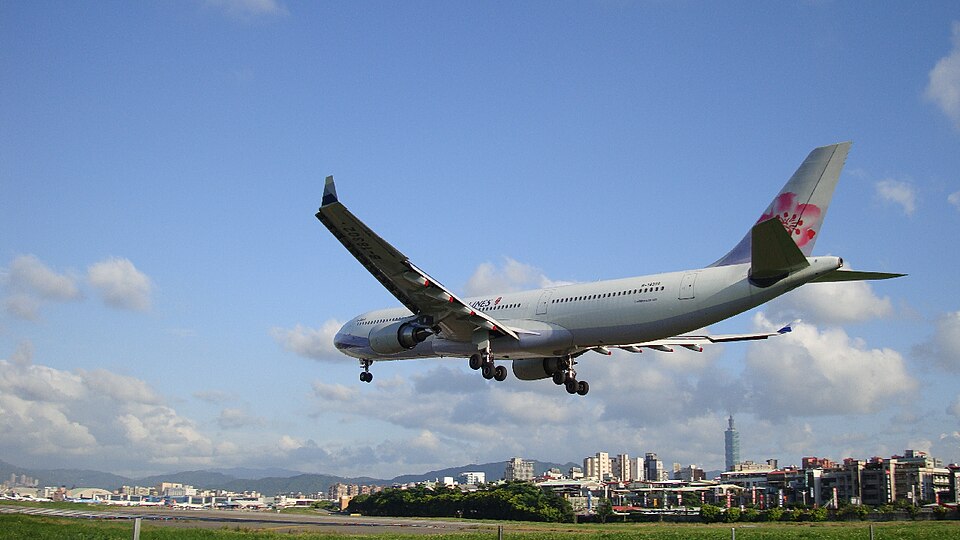
Occurrence
On June 14, 2020, China Airlines scheduled passenger flight CI202, an Airbus A330-302 (registration B-18302), departed Shanghai Pudong International Airport for Taipei Songshan Airport. The aircraft carried 2 flight crew members, 9 cabin crew members, and 87 passengers, totaling 98 persons on board. The aircraft took off at 1625 with the captain as pilot flying and the co-pilot as pilot monitoring. During descent, the flight crew received ATIS information L and were instructed to use the ILS for runway 10. The Electronic Flight Bag calculated a remaining runway distance of 362 feet with autobrake set to low.
Approximately six minutes before landing, the pilot flying was alerted to rain near Songshan Airport; the pilot monitoring reviewed the latest weather and learned of a tailwind from 280 degrees at 6 knots with light thunder shower rain. At 1743:21, during final approach at an altitude of about 3,008 feet, the tower reported visibility dropped to 2,500 meters. At 1743:51, the tower cleared the flight to land on runway 10, cautioning tail winds from 250 degrees at 9 knots. At 1744:37, the flight crew conducted the landing checklist and the pilot flying requested to set autobrake from low to medium due to weather changes.
At 1746:54, the aircraft touched down between 1,500 and 2,000 feet from the runway 10 threshold, with a pitch of about 4.2 degrees, roll to the right of about 1.1 degrees, and magnetic heading of about 94 degrees. Ground speed was 147 knots (indicated airspeed 135.5 knots) with a maximum vertical acceleration of 1.28 g. Ground spoilers began to deploy. One second after touchdown, the left and right main gear shifted between air and ground modes for about 0.75 and 0.5 seconds respectively. Three seconds after main gear touchdown, the autobrake system fault was recorded; one second later, all three flight control primary computers (FCPC1, FCPC2, FCPC3) failed simultaneously, causing the spoilers to retract and loss of ground spoiler function. The pilot monitoring called out "reverse" as the nose gear touched down. The nose gear then cycled between air and ground modes for approximately seven seconds.
At 1746:59, the pilot flying asked twice if autobrake was on; the pilot monitoring replied it was not. At 1747:04, the pilot flying called out "manual brake" and applied full brake pedal, resulting in normal brake hydraulic pressure of 448 psi and longitudinal acceleration of -0.1 g. At 1747:07, the pilot monitoring reported "reverse no green"; one second later, the pilot flying requested assistance with braking. Both pilots then applied full manual brake pressure, with normal brake pressure reaching up to 2,560 psi and longitudinal acceleration fluctuating between -0.05 g and -0.47 g. The aircraft came to a full stop 30 feet before the end of runway 10. No damage to the aircraft or injuries to occupants occurred.
Investigation
The Taiwan Transportation Safety Board (TTSB) conducted the investigation under the Transportation Occurrence Investigation Act of the Republic of China and Annex 13 to the Convention on International Civil Aviation. The investigation team included representatives from the French Bureau d'Enquêtes et d'Analyses (BEA), Airbus, EASA, China Airlines, and Taiwan's Civil Aeronautics Administration (CAA). The draft final report was reviewed at TTSB's 25th Board Meeting on May 7, 2021, and after comments, the final report was approved at the 29th Board Meeting on August 13, 2021.
Findings
The investigation identified 15 findings. The probable cause was the simultaneous failure of all three flight control primary computers (FCPCs) during touchdown due to an undue triggering of the rudder order COM/MON monitoring in all three FCPCs. At touchdown, the combination of high COM/MON channels asynchronism and pilot pedal inputs caused the rudder order difference between channels to exceed the monitoring threshold. FCPC1 failed first, followed by FCPC2 and FCPC3, resulting in the loss of thrust reversers, ground spoilers, and autobrake, increasing the landing distance.
Other findings noted that the flight crew were properly certificated and qualified, and their actions during approach, flare, landing, and rollout complied with standard operating procedures. The crew maintained good interaction and situational awareness. The aircraft's deceleration performance after manual braking was between medium and good, consistent with the reported wet runway conditions. The runway surface friction and geometry of Songshan Airport runway 10 met relevant standards. Airbus reviewed in-service experience and confirmed no other triple PRIM fault at touchdown had been reported on A330/A340 aircraft since entry into service.
Safety Actions
During the investigation, Airbus implemented proactive safety actions to address the lack of robustness in the FCPC COM/MON rudder order monitoring. Taiwan's CAA released an Aviation Safety Bulletin on July 13, 2020. China Airlines issued Flight Operation Information FOI 2020-034 on July 3, 2020, and updated version FOI 2021-007 on February 22, 2021, to inform its flight crews.