Flight History
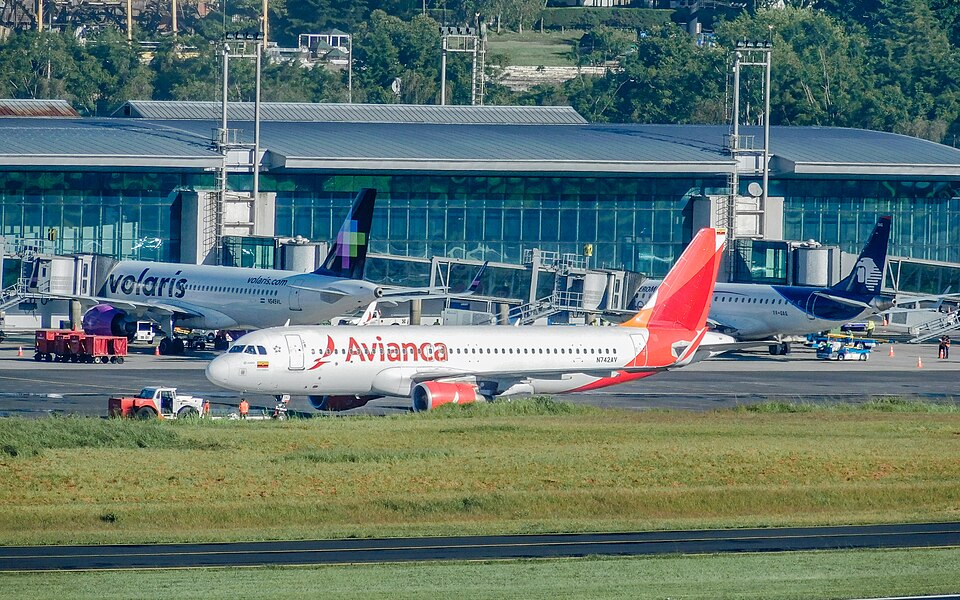
On 3 July 2017, the crew of Avianca flight AVA 9882 operated an Airbus A320-214, registration N742AV, on a repositioning flight (no passengers) from Leticia (SKLT) to Cali (SKCL). The aircraft departed Leticia at 02:07 HL and climbed to FL380. At 03:16:49 HL, while established on airway UL655 at 103 NM from Cali, Bogotá Control cleared the flight to descend to FL190. The crew began descent with both autopilots engaged in DES mode and auto-thrust at IDLE.
At 03:21:48 HL, the crew contacted Cali Approach, which cleared them for an ILS approach to runway 02 and authorized descent to 6000 ft. The aircraft passed FL195 in an area where the minimum safe altitude (AMA) was 19,700 ft.
GPWS Activation
At 03:25:03 HL, the radio altimeters began registering decreasing heights (5200 ft RA on RALT1, 5400 ft RA on RALT2) while the aircraft was descending at 2,800 ft/min at 322 kt. At 03:25:23 HL, crossing 13,300 ft, the EGPWS issued a "TERRAIN TERRAIN" warning. The first officer (PF) disengaged the autopilot but initially continued descending at 2,900 ft/min. The aircraft reached a minimum altitude of 13,100 ft and a minimum radio altitude of 1,800 ft RA. The GPWS "PULL UP" warning activated for 3 seconds. The crew then executed an evasive climb, reaching 14,900 ft. After 30 seconds, they re-engaged the autopilot and continued to a normal landing at Cali.
Probable Causes
The investigation determined two probable causes:
1. The flight crew lost situational awareness (SAW) by not considering their position and the required descent path relative to MEA and MORA altitudes, accepting ATC instructions without analysis, leading to an undesired aircraft state (UAS) and a dangerous terrain proximity (CFIT).
2. ATC from Bogotá Control assigned a flight level below the established minimum (FL190 vs. MEA FL250), and Cali Approach confirmed the incorrect level and did not notice the aircraft descending below the MEA.
Contributing Factors
Contributing factors included the captain's accumulated fatigue, which may have reduced his ability to analyze the operational environment and react appropriately to the GPWS warning, and the lack of an in-flight briefing for an unusual route, indicating complacency given the crew's limited experience on the SKLT–SKCL route.