Takeoff and Abort
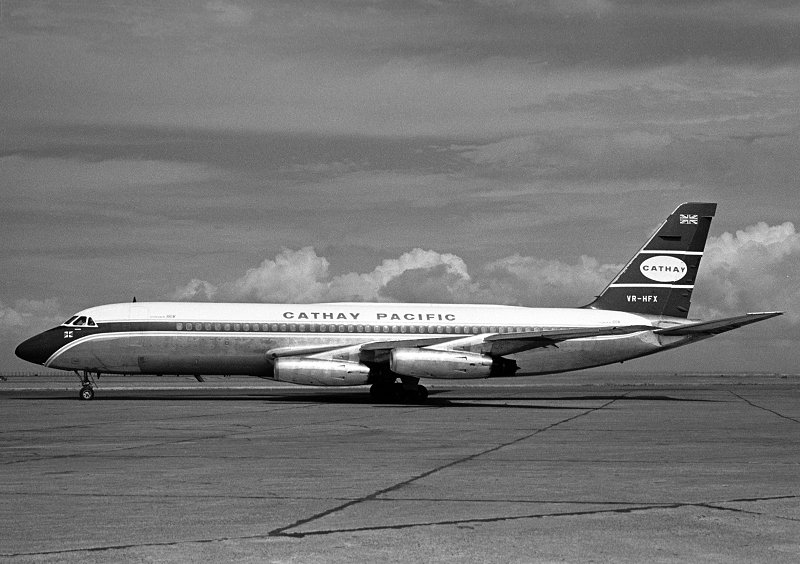
On the day of the accident, Flight CX033 was a scheduled passenger flight from Hong Kong to Bangkok with an additional en-route stop at Saigon to transport a backlog of passengers. A Check captain joined the flight. The co-pilot was flying the aircraft from the left-hand seat while the pilot-in-command occupied the right-hand seat to assess his performance. The Check captain occupied the jump seat behind the co-pilot to monitor both pilots.
At 10:31, the aircraft commenced taxiing for takeoff on runway 13. Tower passed a wind check of 010/10 kt, acknowledged by the aircraft when takeoff clearance was given. At 10:34, a rolling takeoff commenced. The co-pilot increased power to 1.5 EPR, after which the engineer set the engines at maximum power. The aircraft accelerated normally, but at a speed slightly under 120 kt (as reported by the co-pilot), heavy vibration was experienced. The vibration increased in severity, and the co-pilot decided to discontinue the takeoff. He called "abort", closed the power levers, applied maximum symmetrical braking, and selected the spoilers. The abort action was prompt except for a delay of 4–5 seconds in applying reverse thrust, which was then used at full power throughout the remainder of the aircraft's travel.
Sequence of Events During Abort
No significant decrease in the rate of acceleration occurred until after an indicated airspeed of 133 kt had been attained. There was then a slow build-up of speed to 137 kt over the next 2 seconds, after which deceleration commenced. Both pilots were applying full brakes, but neither felt the antiskid cycling. The aircraft continued to run straight for some distance after initial braking was applied, but then a veer to the right commenced. Opposite rudder was used but failed to check this, forcing the use of differential braking to the extent that eventually the right brake had been eased off completely, while maximum left braking, full left rudder, full lateral control to the left, and nose-wheel steering were being applied. These actions were only partly effective, and the aircraft eventually left the runway and entered the grass strip. The turn to the right continued until finally the aircraft crossed the seawall.
Impact and Aftermath
All four engines separated on impact with the sea. The nose of the aircraft was smashed in, and the fuselage above floor level between the flight deck and the leading edge of the wing was fractured in two places. The aircraft spun to the right and came to rest some 400 feet from the seawall. A passenger was killed, while 33 others were injured.