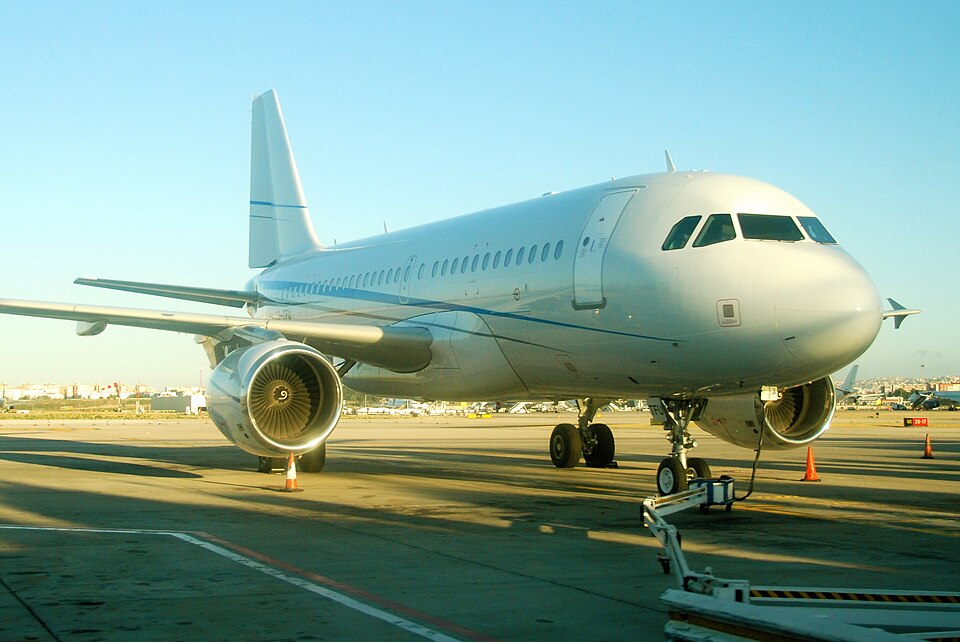
On July 9, 2009, an A319 (registration CS-TFU) was involved in an aviation accident near In prossimità punto ROBAS, IT. This summary draws on records from the Italian National Flight Safety Agency (ANSV).
On 9 July 2009, a serious airprox occurred near ROBAS involving Airbus A319 CS-TFU, A320 G-MIDX, and A320 F-GKXF. Separation reductions occurred between the aircraft during descent and level changes.
Overview and Event Description On 9 July 2009 at 09:10 UTC, a serious airprox incident occurred near the ROBAS waypoint in upper airspace under the jurisdiction of Roma Control, within the MIE (Milano Est) sector. The event involved three aircraft: an Airbus A319 with registration CS-TFU (callsign WHT923P), an Airbus A320 with registration G-MIDX (callsign BMA8343), and an Airbus A320 with registration F-GKXF (callsign AFR2221). A fourth aircraft, operating as EZS1123, also played a role in the event's dynamics. The incident was characterized by a medium-severity reduction in separation between WHT923P, descending from FL360 to FL350, and BMA8343 at FL350, followed by a less severe reduction between WHT923P, which had climbed back to FL360, and AFR2221 at FL360. ## Flight Histories and Operational Context WHT923P was operating from Lisbona (LPPT) to Monaco (EDDM), planned on airway UM985 at FL360. BMA8343 was operating from Manchester (EGCC) to Zakinthos (LGZA), planned on airways UL612/UL153/UL995 at FL350. AFR2221 was operating from Tel Aviv (LLBG) to Paris (LFPG), planned via UM872 at FL360. The aircraft entered the MIE sector at different times: AFR2221 at approximately 08:57, BMA8343 at 08:58, and WHT923P was in contact with the adjacent MIW sector from 08:56. A strong west-northwest wind component created significant ground speed differences between the aircraft, with WHT923P having over 100 knots advantage in ground speed compared to AFR2221. ## Sequence of Events At approximately 09:07, a controller handover occurred in the MIE sector. The incoming controller received the first communication from EZS1123, which was climbing to FL320 with a cruise request of FL370. The aircraft was subsequently authorized to climb to FL330, then FL340, and finally FL350. At approximately 09:09:40, the four aircraft converged near ROBAS. The STCA (Short Term Conflict Alert) function activated on the controller's screen, highlighting a potential conflict between WHT923P and AFR2221, both at FL360. The controller authorized WHT923P to descend to FL350, where BMA8343 was simultaneously present on an intersecting route from the left. The controller communicated to WHT923P to maintain present heading. The crew read back 'Descending now flight level 3-5-0 maintain heading WHT923P.' This read-back was not perceived by the controller, who then instructed AFR2221 to turn right 20 degrees and WHT923P to turn right to heading 090. As WHT923P left FL360, an additional STCA alarm activated between WHT923P and BMA8343, adding to the existing alarm with AFR2221. The controller's response resulted in a partially effective recovery action. ## Outcomes and Findings The incident resulted in a medium-severity separation reduction between WHT923P and BMA8343, with a Closest Point of Approach (CPA) of 2.18 NM/400 feet, and a less severe reduction between WHT923P and AFR2221, with a CPA of 3.83 NM/0 feet. No injuries were reported to crew or passengers. No damage was reported to the aircraft. When asked about TCAS alerts, the three involved aircraft reported having received only traffic advisories, not resolution advisories. ## Investigation and Personnel The investigation was conducted by the Agenzia nazionale per la sicurezza del volo (ANSV) in accordance with Annex 13 to the Chicago Convention. Three air traffic controllers were involved: the outgoing Executive controller (38 years old, radar/area qualified since 2000), the incoming Executive controller (35 years old, radar/area qualified since 2001), and the Planner controller (44 years old, radar/area qualified since 1993). All three had valid psychophysical fitness and had completed continuous training in 2009 prior to the event.