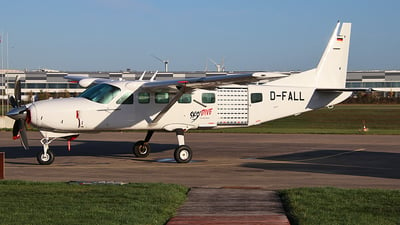
Event Description
On 1 July 2001, at approximately 12:15 UTC, a Pilatus PC-6/B2-H4 (registration D-FALL) departed from Ravenna airport for a parachute jumping mission. Shortly after takeoff, while at low altitude, the aircraft pitched up sharply and then impacted the ground violently on the grass beside the runway. The first contact with the ground involved the left wing and left landing gear nearly simultaneously. The propeller was found to be rotating at high speed at impact, indicating the engine was running. The horizontal velocity was low, as the distance from first impact to stop was short.
Occupants and Injuries
There were 11 persons on board: the pilot and 10 parachutists. All occupants evacuated the aircraft autonomously. Five of them sustained minor injuries. The aircraft was substantially damaged; no other damage occurred.
Aircraft and Personnel Information
The aircraft was a Pilatus PC-6/B2-H4 single-engine turboprop with high wing and three-blade variable-pitch propeller, serial number 860, built in 1988. It had accumulated 3,927 flight hours; the last 100-hour inspection was on 15 June 2001. The pilot, a 45-year-old Italian male, held a valid Commercial Pilot License with ratings for single-engine piston, single-engine turbine, and parachute jumping. He reported approximately 3,000 total flight hours.
Flight Sequence
The accident flight was the thirteenth of the day. Prior to departure, 221 liters of fuel were added. Estimated takeoff mass was about 2,600 kg. The pilot stated that after the previous landing, he set the trim to position 2 and zeroed flaps for boarding. Before the final takeoff, he set flaps to takeoff position and rechecked the trim setting. During the takeoff roll at about 50-60 knots, he rotated and then retracted flaps. Shortly after, the aircraft pitched nose-up. The pilot pushed the control bar forward to level the attitude, but suspected a trim failure. He attempted to disengage the trim unsuccessfully while maintaining attitude, then managed to prevent a stall or spin. The aircraft landed hard in a flat attitude.
Witness Statements
A parachute instructor reported that at an estimated height of 50-100 meters, the aircraft pitched up steeply until stalling. He observed the pilot reduce power, the aircraft leveled, then the pilot reapplied power before impact. Another parachutist sensed an unusual movement at about 30-40 meters height, followed immediately by ground impact.
Technical Examinations
In coordination with the judicial authority, technical tests were conducted. The airspeed indicator, altimeter, and variometer were checked with no anomalies. The electrical system, stabilizer trim, and flaps were tested with the support of a certified company. Due to front damage, electrical testing was performed aft of the firewall using an external battery; the system was found functional. The trim system operation was examined: the normal and alternate trim modes were simultaneously active; the "trim interrupt" switch was actually an actuator disconnect per the wiring diagram. Inspection of the wreckage revealed that the electrical trim indicator showed full "nose up" with power applied (without power it rested in "nose down"). The mechanical position of the stabilizer trim was at the full "nose up" stop. Thus the cockpit indication and the physical trim position were consistent.
Probable Cause
Not stated.