Introduction
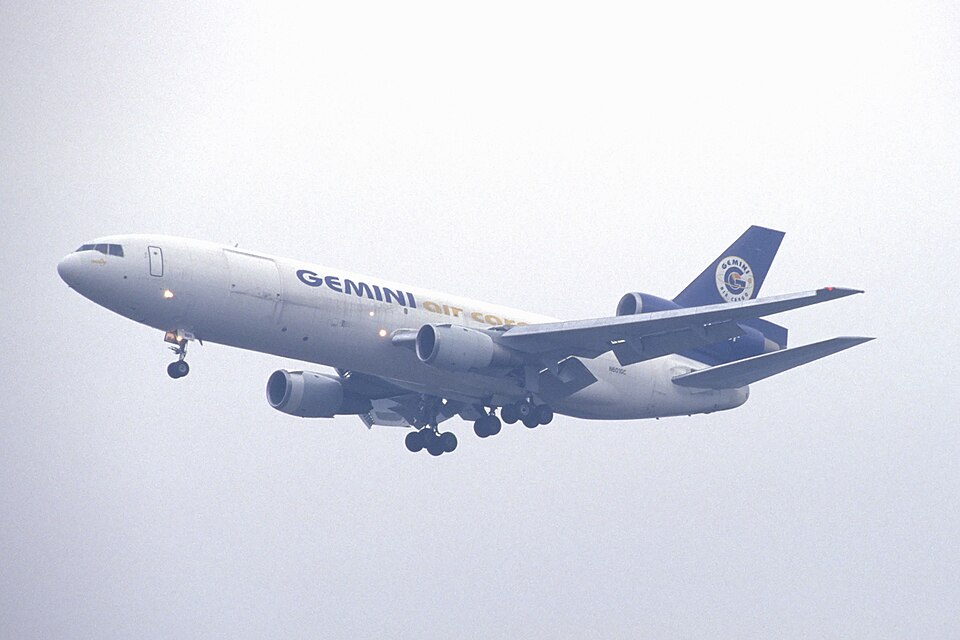
On 1 October 2000, a McDonnell Douglas DC-10-30F cargo aircraft (registration N601GC) experienced a bird strike shortly after departure from Shannon Airport, Ireland. The aircraft was operating a scheduled cargo flight from Stockholm, Sweden, to San Juan, Puerto Rico, with a refuelling stop at Shannon. The crew consisted of five members, and there were no passengers on board. No injuries were reported from the incident.
History of the Flight
The flight from Stockholm to Shannon was uneventful. Weather conditions at Shannon included wind from 270° at 27 knots gusting to 40 knots, visibility 8 kilometres in light showers, broken cumulonimbus clouds at 1,800 feet, with temporary deterioration to wind 290°/30 knots gusting 45 knots and visibility 5 kilometres. Severe turbulence was forecast, and a windshear warning was in effect. The aircraft took off from Runway 24 using maximum thrust due to company procedures for the poor weather. At approximately 300 feet above ground level, a loud bang and bright flash were observed from the left side. Significant airframe vibration and a rumbling sound followed. The No. 1 (left) engine reverser unlock light and exhaust gas temperature over-temperature warning illuminated. The commander reduced the No. 1 throttle. The fire warning then activated, and the crew executed the engine fire checklist. The fire indication later extinguished, and one fire extinguisher was discharged. The crew declared an emergency with Shannon Approach Control and, deeming weather unsuitable for a single-engine approach, requested diversion to London or possibly Brussels. They later specified an airfield in England with a 10,000-foot runway and good weather. The aircraft climbed to cruising level and was vectored east. During the flight, fuel was jettisoned. The crew were offered RAF Brize Norton as an alternative but decided to continue to London Heathrow, where the aircraft landed without further incident.
Diversion and ATC Procedures
The commander selected London Heathrow due to its 10,000-foot runway. However, the aircraft was routed over the centre of London on approach to Runway 27R. The Manual of Air Traffic Services (MATS) Part 1 recommends that aircraft in emergency should not be routed over densely populated areas if possible. The controller did not advise the crew of this procedure or that the approach would overfly built-up areas. The commander was not familiar with the London area, and if informed, he might have reconsidered the diversion. Three safety recommendations were made, including one (Recommendation 2001-35) for controllers to inform pilots if an intended route crosses densely populated areas.
Engine and Damage
The No. 1 engine suffered severe damage from the bird strike and was deemed beyond economic repair. Large nacelle components separated and struck the left inboard aileron and flap, causing impact damage. The pylon web was cracked. The aircraft's flight data recorder showed that engine parameters fluctuated after the strike, with a drop in fan speed and increase in exhaust gas temperature. The engine eventually ceased running after the fuel selector was moved to the OFF position.
Safety Recommendations
The investigation made three safety recommendations. One addressed the method of attachment of the aft centre body on the CF6-50 engine. The other two pertained to air traffic control procedures for handling aircraft in emergency situations, specifically ensuring pilots are aware of routing over densely populated areas.