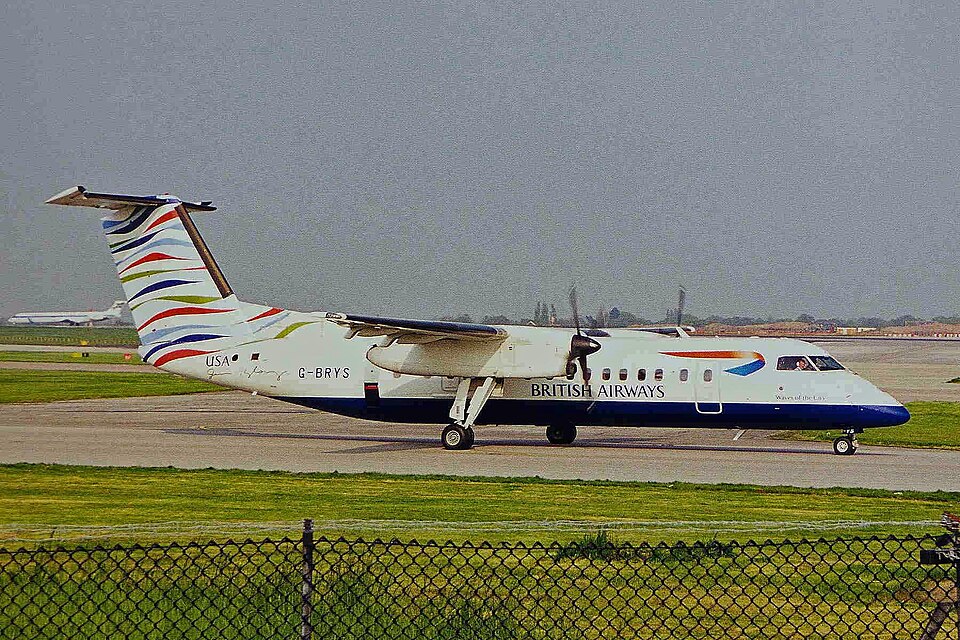
Aircraft and Crew
The aircraft, a De Havilland Canada DHC-8-311 (registration G-BRYS) with two Pratt & Whitney Canada PW-123 turboprop engines, was on a public transport flight from Manchester to Aberdeen. The commander, aged 51, held an Air Transport Pilot's Licence with 4,800 total hours (200 on type). The first officer, aged 22, had 458 hours on type. Four crew and 48 passengers were on board; no injuries or damage were reported.
Flight Sequence
The flight departed Manchester at 0629 hrs. During the cruise, the autopilot was engaged in altitude hold and lateral navigation modes. The commander briefed for a manually flown radar vectors ILS approach to Runway 34. The ATIS reported calm wind, few clouds at 200 ft, scattered at 800 ft, and broken at 1,200 ft. At 0735:30 hrs, during descent to FL90, the aircraft was transferred to Aberdeen approach. The crew requested direct to an 8-mile centre fix for Runway 34. The commander re-engaged the autopilot in L NAV mode.
ILS Deviation and Go-Around
Cleared to descend to 3,200 ft and then 2,000 ft, the crew reported localiser established at 0745:50 hrs. However, they subsequently reported at 4.5 DME, and the approach controller noted the aircraft was two miles east of the ILS. The crew acknowledged turning back. After transfer to tower frequency, the crew reported at 3.5 DME but stated they were not visual and initiated a go-around. The tower cleared them to climb to 3,000 ft. Radar data showed the aircraft deviated up to 2 km east, coming within 650 m laterally and 82 ft vertically of a radio transmitter mast in Cummings Park.
Autopilot and FDR Analysis
Flight data recorder analysis revealed that the commander had pre-set the heading bug to 344° (inbound course). After turning onto the inbound course, he selected HDG and then V/L and NAV buttons for localiser capture but did not set the ILS inbound QDM on the course selector; it was 90° off. Localiser capture activated with a small offset, but the autopilot applied increasing right bank up to 29.88°, causing the aircraft to deviate. The commander then selected heading and speed modes, reduced engine torques, and at 1,874 ft agl disengaged the autopilot. He initiated a go-around at 430 ft agl. The go-around mode was not activated. During the subsequent climb, the aircraft exceeded the cleared altitude of 3,000 ft, reaching 3,800 ft before descending and eventually capturing 3,000 ft.
Weather and Wake Vortex Consideration
The 0750 hrs weather reported calm surface wind, visibility 3,500 m in mist, cloud few at 200 ft, scattered at 600 ft, overcast at 1,200 ft. A Boeing 757 had landed seven minutes earlier. Although wake vortex was considered as a possible cause for the roll, FDR data confirmed the roll was not due to wake vortex.
GPWS
The aircraft's GPWS issued a warning during the approach. The crew mentioned a spurious terrain warning.