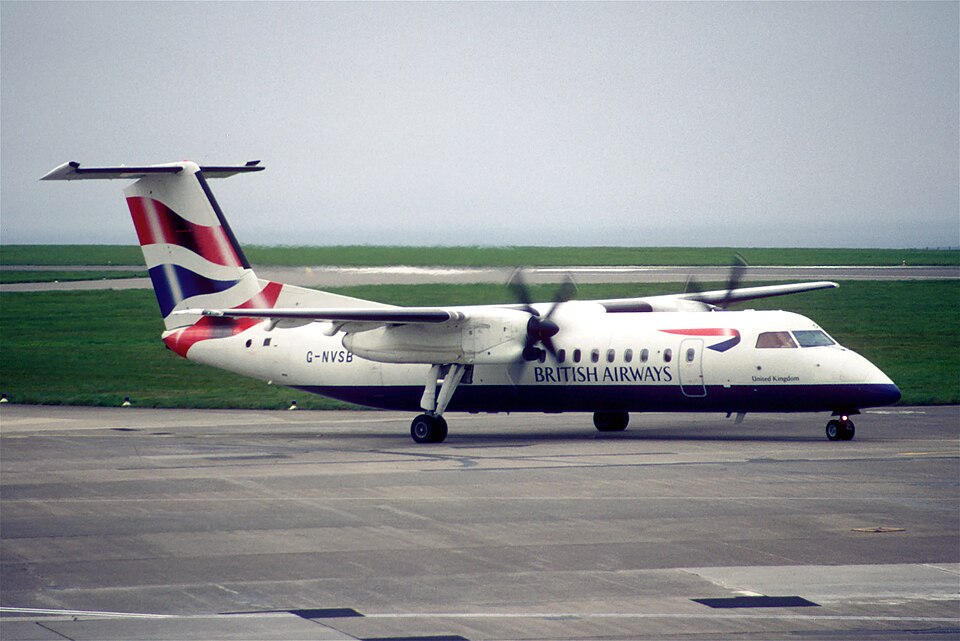
History of the Flight
The aircraft was operating a scheduled passenger flight from Manchester to Aberdeen. Prior to the flight, the commander and co-pilot were informed that a propeller vibration survey was required during the flight. The commander had flown the aircraft the previous day and noted that vibration levels peaked between 900 rpm and 1,200 rpm, but the monitoring equipment was not functioning correctly. On the incident flight, the co-pilot was the pilot flying. After engine start, normal checks were completed, but airframe vibration was felt during de-icing checks at 900 rpm. During takeoff, the commander felt the vibration had worsened. After flap retraction, the crew discussed a possible return.
In accordance with standard procedure, the autofeather system was deselected and engine power reduced, at which point a 'pop' and 'bang' were heard, heavy vibration was felt, and the aircraft yawed right. The torque indicator for the No 2 engine showed 0%, and the engine shutdown drill was initiated. The propeller did not feather when the condition lever was selected to START & FEATHER; ALTERNATE FEATHER also failed. The propeller speed remained at about 500 rpm for the remainder of the flight.
A MAYDAY call was made, and ATC provided a priority visual circuit for runway 24R. The cabin crew were briefed to prepare for an emergency landing. At about four miles from touchdown, the landing gear was selected down, but only the main landing gears indicated down and locked; the nose landing gear indicated 'unsafe'. The alternate landing gear release was used successfully, and an uneventful landing followed. The aircraft vacated the runway and was met by Rescue and Fire Fighting Service, who reported signs of overheating on the left main gear wheels. A precautionary evacuation was carried out using the integral airstairs.
Aircraft Examination
Examination revealed that the No 1 propeller blade support bearing of the right propeller assembly had failed catastrophically. This failure resulted in large imbalance loads through the engine, leading to fracture of the Power Turbine (PT) shaft. Consequently, the PTs oversped, causing loss of PT blades and an exhaust baffle plate from the rear of the engine. The propeller failed to feather because a ball from the failed bearing became jammed between the propeller blade root and the propeller hub. The origin of the bearing failure was not determined, although metallurgic examination revealed that cracking had been occurring for some time. Six days prior to the incident, heavy vibration was reported, but vibration survey equipment was not available at the time, so the defect was deferred per the operator's technical instructions. When vibration survey equipment was later fitted, it was set up incorrectly, and a full survey was not carried out before the incident flight.
Weather
The weather at the time was good, with wind 150°/5 kt, visibility 9 km, and broken cloud at 8,800 ft.