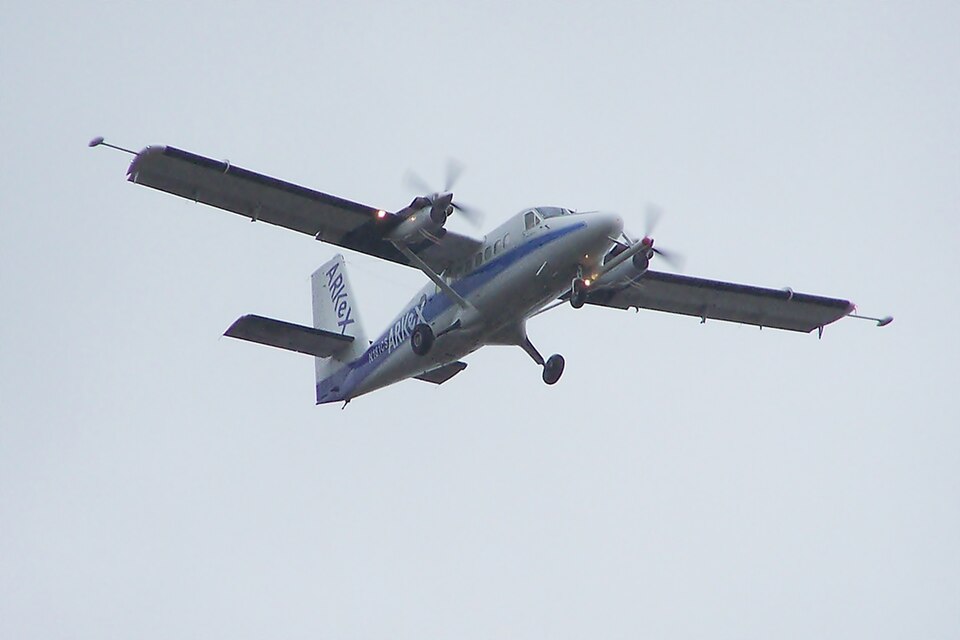
Engine power reduction leads to loss of control during landing

No fatalities • Louisburg-North Raleigh, United States of America • Landing (descent or approach)

A pilot experienced an uncommanded engine behavior during the final approach of an aerial observation flight, resulting in an excursion into trees.

What happened

During a cross-country aerial observation mission, the pilot was operating a multiengine airplane on the final leg of a landing pattern. As the pilot decreased power to prepare for touchdown, an unusual sound emerged from the right engine, suggesting the propeller was moving toward the beta position. The pilot attempted to rectify the situation by increasing power, which temporarily silenced the noise, but the sound and a noticeable rightward yaw returned as power was reduced again.

Despite applying corrective rudder and aileron inputs to maintain the runway centerline, the aircraft continued to drift. When the pilot transitioned the engine to idle power over the runway, the rightward yaw persisted. An attempt to execute a go-around using full power failed to stabilize the aircraft, as the plane drifted approximately 30 degrees off the centerline. The aircraft subsequently touched down in a grassy area and struck trees. The impact caused the separation of the right wing, the right engine, and the right propeller assembly. There were no fatalities reported in the incident.

Findings

Investigation of the aircraft's maintenance history showed that the right propeller had undergone an overhaul and reinstallation only two days prior to the accident, having flown for nine hours since that service. While testing of the right propeller governor showed no operational anomalies, the speed settings were found to be incorrectly configured. Additionally, the beta valve travel from its neutral position was measured to be out of tolerance.

While it was noted that this mechanical discrepancy could potentially cause improper oil pressure distribution and subsequent blade angle changes, investigators could not confirm if this was the specific cause during the landing. Due to the extent of the impact damage, the condition of the propeller governor control linkage could not be inspected to determine if improper installation or rigging contributed to the propeller moving into the beta position. Ultimately, the exact reason the right propeller moved toward the beta position during power reduction remains undetermined.

Probable cause

The investigation could not definitively determine why the right propeller moved toward the beta position during power reduction, though improper governor settings and out-of-tolerance valve travel were identified.

Frequently asked questions

What happened in the 2015-09-06 De Havilland DHC-6 Twin Otter accident near Louisburg-North Raleigh, United States of America?

A pilot experienced an uncommanded engine behavior during the final approach of an aerial observation flight, resulting in an excursion into trees.

Were there any fatalities in the 2015-09-06 De Havilland DHC-6 Twin Otter accident?

No fatalities were recorded in this accident.

What aircraft was involved and where did it happen?

The accident on 2015-09-06 involved a De Havilland DHC-6 Twin Otter, registration N181CS, operated by Rampart Aviation, at Louisburg-North Raleigh, United States of America.

What was the probable cause of the accident?

The investigation could not definitively determine why the right propeller moved toward the beta position during power reduction, though improper governor settings and out-of-tolerance valve travel were identified.

Loading the flight search…

What you can do on Flight Finder

  • Search flights between any two airports with live fares.
  • By aircraft — pick a plane model (e.g. Boeing 787, Airbus A350) and see every route it flies from your origin.
  • Route map — click any airport worldwide to explore its destinations, or draw a radius to find nearby airports.
  • Global aviation safety — aviation accident database, 40,000+ records since 1980, with map and rankings by aircraft and operator.
  • NTSB safety feed — recent U.S. aviation accidents and incidents from the official NTSB CAROL database, updated daily.