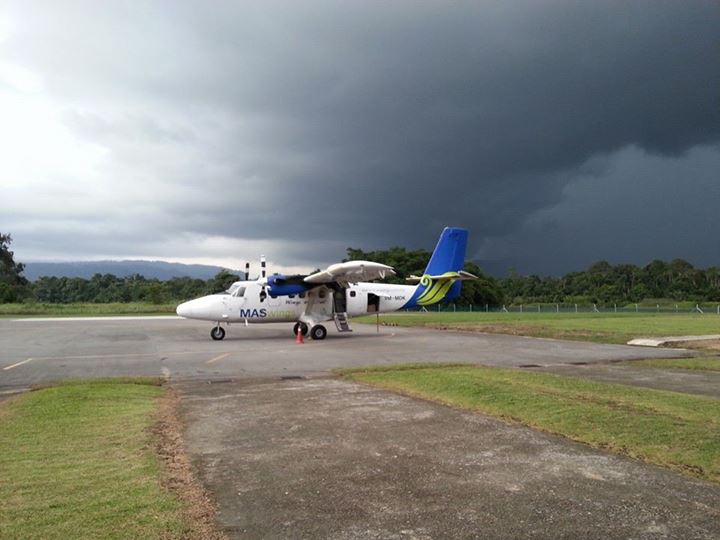
Accident Overview
On an unspecified date, a de Havilland Canada DHC-6 Twin Otter 310 operated by MASwings as flight MH3002 from Kota Kinabalu Airport (BKI) to Kudat Airport (KUD) in Malaysia sustained substantial damage in an accident. The copilot and one passenger died; four other occupants were injured. The captain was the pilot flying and the first officer was pilot monitoring.
First Approach
As the aircraft approached Kudat, the tower reported wind at 270 degrees at 17 knots gusting 31 knots. The crew continued an approach to runway 04, leveling off at 500 feet with flaps set at 10°. The crew noticed a strong tailwind, indicated by an airspeed of 100 knots versus the expected 65 knots for flaps 10°, and the windsock confirmed a tailwind. At 500 feet, the crew initiated a go-around, maintaining runway heading and climbing to 1,000 feet, then performing a left teardrop turn to reposition for runway 22.
Second Approach and Accident
On the approach to runway 22, the captain informed the first officer that if they could not land, they would return to Kota Kinabalu. The aircraft aligned with the centerline with flaps set at 20°. Descending to 300 feet, the wind appeared calm and the captain stated he was committed to land. At 200 feet, the captain called for full flaps. While flaring at approximately 20 feet above the runway, a gust of wind caused the aircraft to veer right, with the right wing low and the nose 45° right of runway 22. The crew applied maximum power to go around, but the aircraft did not climb successfully. The flaps remained at full down. The aircraft continued veering right with a shallow climb rate and failed to clear trees ahead. The full flaps configuration made climbing more difficult. At full power on both engines, the aircraft flew almost perpendicular to the runway at low altitude, struck treetops at the airfield perimeter, then trees behind a house, the roof of a house (kitchen, toilet, dining area), concrete pillars of a car garage, and a lamp post before coming to rest with the left engine still running. A woman and her 11-year-old son in the living room escaped unhurt.
Probable Cause
Based on the official investigation findings, the accident was attributed to multiple factors. The first approach to runway 04 was conducted with a tailwind of 15 knots gusting to 25 knots, contrary to the captain's reported conditions. The demonstrated crosswind landing limit for the DHC-6-310 is 25 knots, and tailwind limit is 10 knots. The aircraft was unstable until past the terminal building. The flap setting of 10° on the first approach was not per company procedures; for tailwind landings, the aircraft must have no more than 10 knots tailwind and flaps no more than 20°. The crew should have initiated a go-around before 500 feet AGL on the first approach. On the second approach to runway 22, wind conditions remained gusty and unfavorable. The full flaps (37°) were used, which should be avoided in gusty winds per SOP. The aircraft was unstable and low on approach. After a sudden gust, the go-around was not properly executed: the flaps were not retracted, and the pitch attitude likely caused speed loss and a stall, preventing climb. The pilots were not in total control of the aircraft.