Background
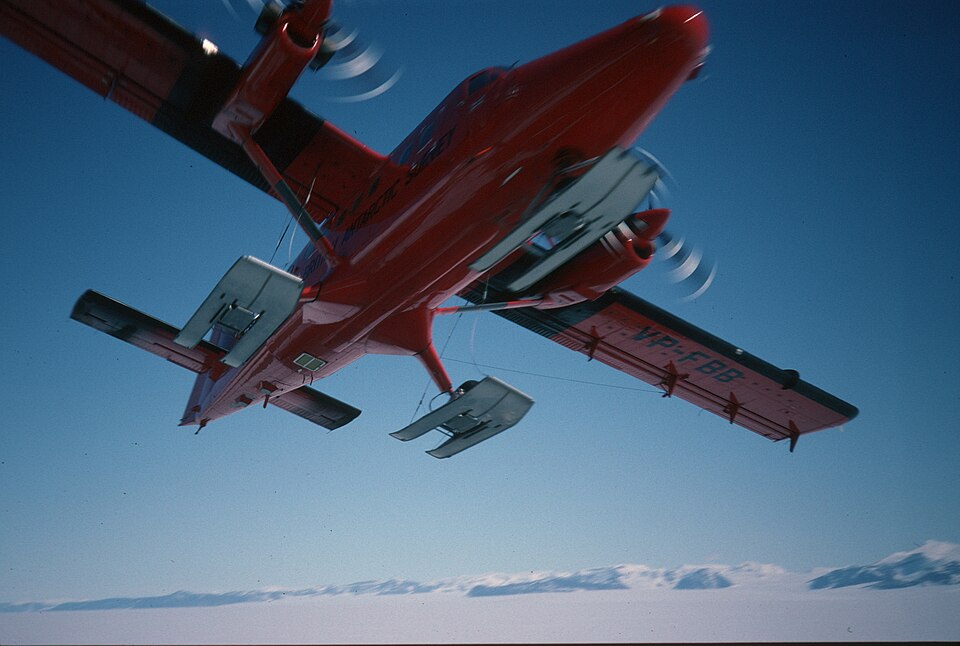
On 7 November 2003, at approximately 2040 hours UTC, a De Havilland DHC-6 Twin Otter (registration VP-FBB) was returning to Rothera Airfield on Adelaide Island, British Antarctic Territory, after a flight to Fossil Bluff, a forward logistic facility about 225 nautical miles to the south. The aircraft was operated as a private flight with one pilot and one passenger on board. The pilot held an Airline Transport Pilot's Licence, was aged 43 years, and had accumulated 9,420 total flying hours, including 1,854 hours on the Twin Otter type. His recent flying experience included 164 hours in the last 90 days and 67 hours in the last 28 days, but his recent flying had been on a De Havilland Dash 7; the accident flight was his first on the Twin Otter for several months.
History of the Flight
Rothera Airfield has a gravel runway oriented 18/36. Recent snow had been cleared, but a thaw left the surface softer than normal. The weather was daylight and fine. About half an hour before the aircraft's arrival, the wind changed suddenly from a light westerly to an easterly at 20 knots, gusting to 30 knots—a phenomenon known to be caused by katabatic flow from the surrounding mountains. Wind measurement facilities included an anemometer near the centre of the airfield, which was affected by buildings and high ground to the east, and a second anemometer on the hill to the east providing area wind data. Two windsocks were located at each runway end.
The return flight was uneventful until the approach. The runway anemometer reported wind 360°/10 knots, while the area anemometer reported 070°/20 knots. The pilot made an approach to Runway 36 with 20–25 degrees of flap. After landing, he had difficulty maintaining directional control and carried out a go-around. During the approach, he observed an easterly wind from the sea surface and confirmed with a pilot on the ground that the windsock near Runway 18 also indicated an easterly wind. He then decided to approach Runway 18, prepared for another go-around if necessary.
The second approach appeared normal, with touchdown approximately 200 metres along the runway. After touchdown, the pilot applied some braking, full right rudder, and full left aileron to keep the aircraft straight and wings level. Concerned about a possible go-around, he used little or no reverse thrust. Initially, directional control seemed adequate, but as the aircraft neared the runway midpoint, it began to veer left. The pilot attempted nosewheel steering, then decided to go around, but the aircraft veered further left. The nosewheel detached, the aircraft tipped right until the right wing touched the runway surface, and it flipped over in a forward somersault, pivoting about the nose and right wing tip. The aircraft came to rest inverted approximately 520 metres from the runway threshold. The pilot and passenger vacated through the right cockpit window, suffering minor abrasions and bruising. Emergency services arrived quickly, shut down the right engine, and applied a foam blanket.
Damage and Injuries
The nose cone was crushed, the nosewheel detached, and the wing, fuselage, and vertical stabilizer sustained moderate damage. The propellers and engines suffered severe damage. Both occupants sustained minor injuries. An examination of the fractured nose oleo by the operator's engineers found no pre-existing fatigue.
Operational Aspects
Ground marks on the runway indicated that the aircraft began veering left about 300 metres from the threshold, with very little weight on the left mainwheel. Nosewheel marks deepened and showed sideways travel; the nose ski contacted the runway before the nosewheel detached. Right mainwheel marks also showed sideways movement, and the right wing tip contacted the runway about 13 metres before the aircraft came to a halt, indicating very slow speed at the time of the somersault.
The pilot and operator provided full reports, noting several factors. The use of flap settings beyond 20 degrees reduces aileron effectiveness and is not normally advised in strong crosswinds. The pilot did not apply full reverse thrust due to concern about a go-around, resulting in slower deceleration, which delayed the aircraft weight settling on the wheels and extended the landing roll into an area where wind direction and strength changed. The chief pilot considered the failure to bring the aircraft to a halt quickly as the most significant causal factor. The decision to go-around was late. The softer-than-normal runway allowed landing gear to dig in more readily. Asymmetric thrust could have assisted directional control. Although the pilot was within legal currency requirements, his recent flying on a Dash 7 meant he lacked recent Twin Otter experience; both he and the chief pilot felt this should have been given more emphasis. The Aircraft Flight Manual cautions that nosewheel steering should not be used until taxi speed. The chief pilot noted difficulty applying full into-wind aileron while using nosewheel steering due to the control mounting. After the accident, the operator conducted a review of currency requirements, crosswind landing techniques, and local wind effects at Rothera.