Flight Details
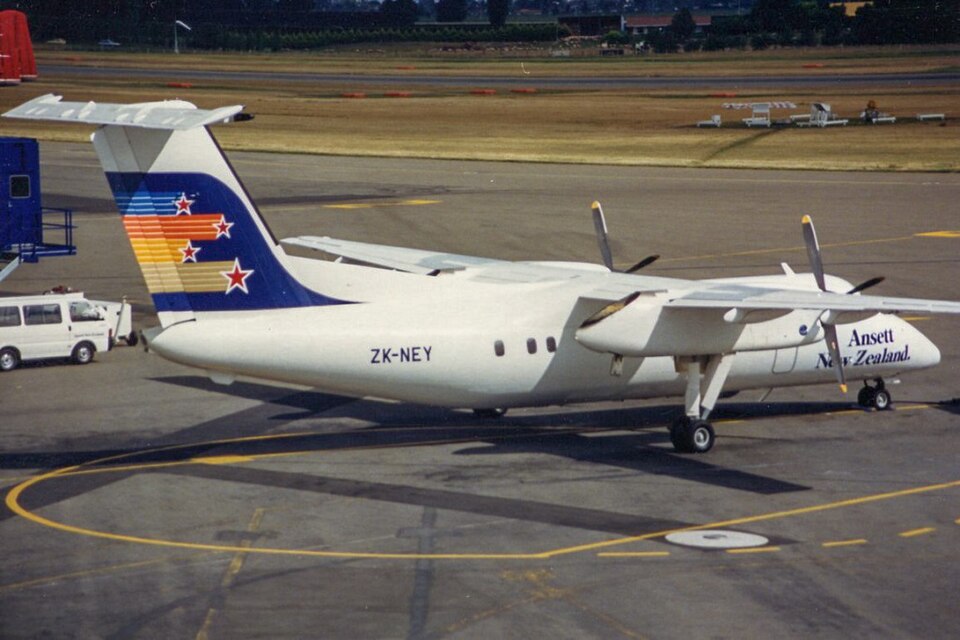
At 08:17, Ansett New Zealand Flight 703 departed Auckland (AKL) as scheduled, bound for Palmerston North (PMR). The aircraft was a Dash 8.
Approach
To the north of Palmerston North, the pilots briefed for a VOR/DME approach to runway 07, their preferred approach. Air Traffic Control subsequently specified the VOR/DME approach for runway 25 due to departing traffic, so the pilots re-briefed for that instrument approach. Instrument meteorological conditions prevailed, with the aircraft flying in and out of stratiform cloud; continuous cloud occurred during most of the approach. The aircraft was flown accurately to join the 14 nautical mile DME arc, then turned right to intercept the final approach track of 250° magnetic to the Palmerston North VOR. During the right turn, the power levers were retarded to flight idle. Shortly afterward, the first officer advised the captain, "....12 DME looking for 4000 (feet)." The final approach track was intercepted at approximately 13 DME and 4700 feet, and the first officer advised Ohakea Control that "Ansett 703" was "established inbound."
Landing Gear Malfunction
Just prior to 12 miles DME, the captain called for gear down. The first officer asked him to repeat and then responded, "OK selected and on profile, ten - sorry hang on 10 DME we're looking for four thousand aren't we so - a fraction low." The captain said, "Check, and Flap 15." This was not acknowledged, but the first officer said, "Actually no, we're not, ten DME we're..... (the captain whistled at this point) look at that." The captain noticed that the right hand main gear had not locked down, stating, "I don't want that." The first officer replied, "No, that's not good is it, so she's not locked, so Alternate Landing Gear...?" The captain acknowledged and said, "Alternate extension, you want to grab the QRH?" After the first officer's affirmative, the captain continued, "You want to whip through that one, see if we can get it out of the way before it's too late." The captain then said, "I'll keep an eye on the airplane while you're doing that." The first officer located the "Landing Gear Malfunction Alternate Gear Extension" checklist in Ansett New Zealand's Quick Reference Handbook (QRH) and began reading it. He started with the first check, but the captain told him to skip through some checks. The first officer responded and resumed reading and carrying out the necessary actions. It was the operator's policy that all items on the QRH checklists be actioned or proceeded through as directed by the captain. The first officer started carrying out the checklist, and the captain advised him to pull the Main Gear Release Handle.
Collision
Then the Ground Proximity Warning System (GPWS) audio alarm sounded. Almost five seconds later, the aircraft collided with terrain. The Dash 8 collided with the upper slope of a low range of hills.