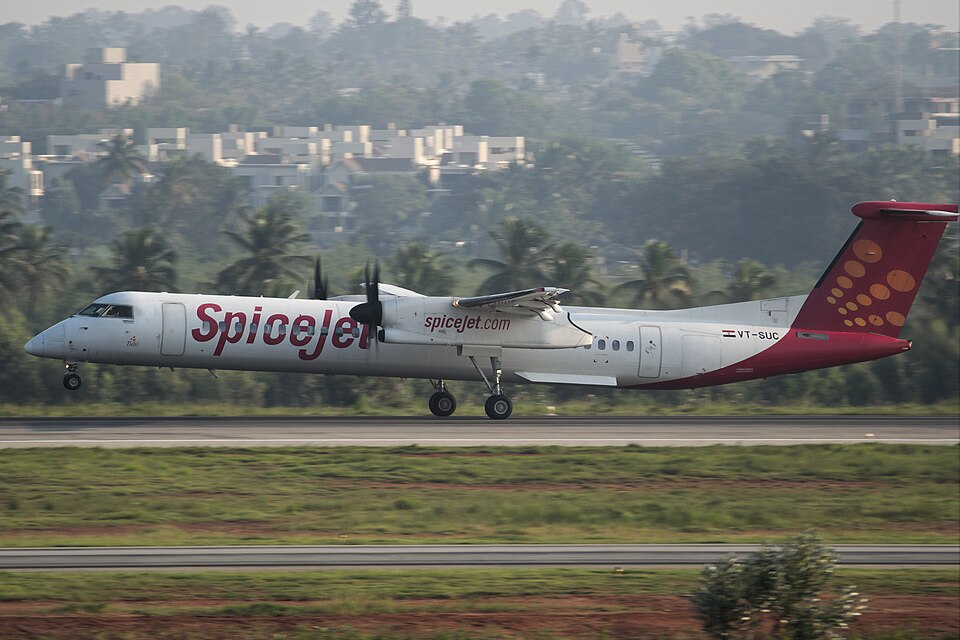
Incident
On December 4, 2015, a Bombardier Q-400 aircraft, registered as VT-SUC and operated by SpiceJet Ltd., was involved in a wildlife strike accident at Jabalpur. The aircraft was performing scheduled flight SG2458 from Mumbai to Jabalpur. During the landing roll on runway 06, approximately five to six seconds after touchdown at around 1350 UTC, the aircraft struck wild boars present on the runway.
Aircraft and Crew
The aircraft was under the command of a pilot holding an Airline Transport Pilot License (ATPL) and was duly qualified on the type. The first officer also held an ATPL and was qualified on the type. Onboard were 49 passengers and two cabin crew members.
Flight and Landing
The aircraft departed Mumbai at approximately 1200 UTC, and the en route flight was uneventful. At 1323 UTC, the crew contacted Jabalpur ATC, which reported prevailing weather: surface winds calm, visibility 5000 meters, haze, nonsignificant clouds, and temperature 24°C. At 1342 UTC, the pilot requested a visual approach for runway 06, and ATC cleared the aircraft for the approach, asking for confirmation when the runway was in sight. At 1347 UTC, the pilot confirmed the runway in sight and requested landing clearance, which was granted. The aircraft landed on runway 06, and shortly after touchdown, it struck wild boars.
According to the pilot, due to dawn conditions, the wild boars were not visible during the approach and were only seen after touchdown when they were very close, leaving insufficient time to take evasive action.
Aftermath
The impact with a wild boar involved the left main landing gear, causing it to collapse. The aircraft then began to drift left. Subsequently, the left engine propeller blades contacted the ground and were sheared off. The aircraft dragged on its belly for approximately 182 feet, during which the nose landing gear also collapsed. The aircraft veered left of the runway centerline, exited the runway onto the left side, and came to a final stop on soft ground.
The pilot confirmed with the first officer that there was no fire and gave evacuation callouts. The pilot contacted ATC for assistance, reporting 10 to 11 pigs on the runway. The Crash Fire Tender team and an operational jeep arrived at the site. The pilot shut down the engines, and all passengers were evacuated safely from the right-hand side. There were no injuries to any occupants and no fire.
Probable Cause
The aircraft during its landing roll had a wildlife (wild boars) strike on the runway, resulting in collapse of the left main landing gear and subsequently the aircraft veered to the left of the runway. Contributory factor: The presence of wildlife in the operational area and on the runway was due to several breaches in the boundary wall.