Overview
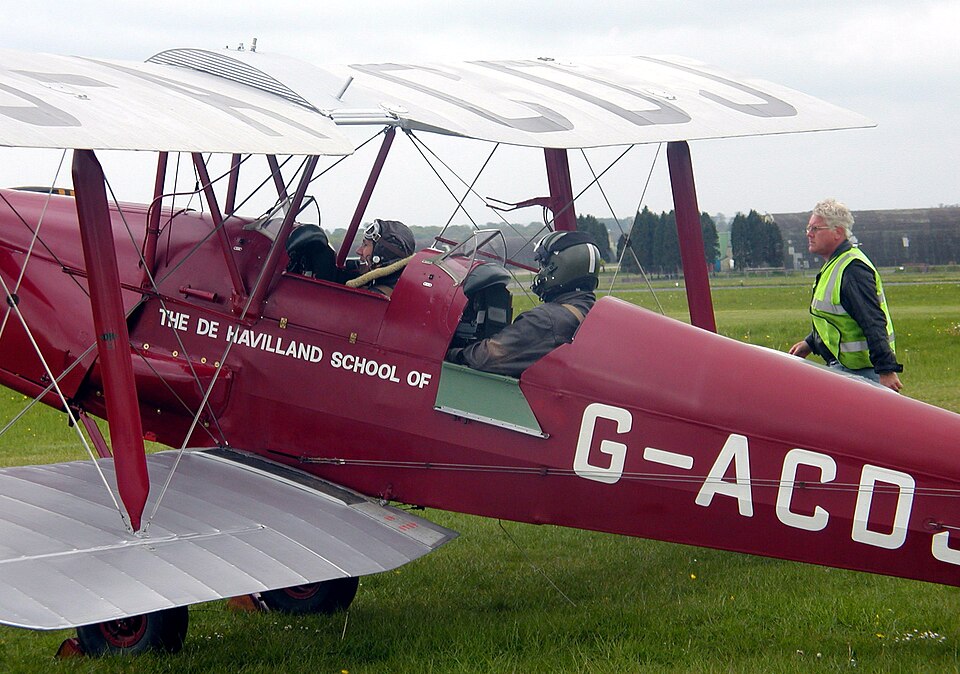
On 18 August 2005 at 1034 hours UTC, a de Havilland DH82A Tiger Moth, registered G-ACDJ, crashed in a field near Remenham, Berkshire, close to Henley-on-Thames. The aircraft was engaged in a private pleasure flight and was destroyed on impact. The pilot and sole passenger both sustained fatal injuries.
Flight History
The aircraft had departed from its maintenance base earlier that morning and flown to White Waltham to conduct short local flights for associates of one of its owners. The accident occurred on the second such flight. As is typical for the Tiger Moth, the passenger occupied the front seat and the pilot the rear. Both occupants wore glass-fibre flying helmets equipped with intercom microphones and headphones.
The aircraft started, taxied, and took off without incident. It flew west to the River Thames, passed over Henley-on-Thames, and then adopted a north-easterly track.
Witness Observations
Multiple witnesses observed the aircraft on the north-easterly track and reported hearing the engine sound reduce markedly. The aircraft then entered a steepening turn to the right, descending rapidly in a tight spiral before striking the ground in a field south of Remenham. The field was large, unobstructed, with a slight slope and mostly rough pasture. Examination of the wreckage later confirmed that the aircraft impacted in a right-hand spin.
Emergency Response and Injuries
Members of the public quickly arrived at the scene and called emergency services. The pilot was conscious and lucid; the passenger was alive but unconscious. Both had extensive injuries. An air ambulance helicopter from White Waltham and a police helicopter with air ambulance capabilities landed at the site. Paramedics treated both occupants at the scene, and the helicopters transported them to local hospitals. The pilot was able to communicate clearly during treatment and transfer but had no recollection of the flight or accident. Both individuals later died of their injuries in hospital.
Pilot Information
The pilot, aged 61, held a Private Pilot's Licence obtained in 1995. His total flying experience was 289 hours, with 107 hours on the Tiger Moth type. In the previous 90 days he had flown 9 hours, and in the last 28 days, 2 hours. He was a member of a syndicate that owned the accident aircraft and had flown it regularly since summer 2001. He had recently completed a biennial check and a renewal of his Single Engine Piston class rating with an examiner on a Piper PA-22. The examiner described him as "an average pilot with a good attitude towards flying" and "a steady pilot who achieved a reasonable standard of flying and knew his limitations."
During the renewal flight, the examiner put the aircraft into a spin, and the pilot recovered correctly with guidance. When the examiner suggested the pilot practise an entry and recovery, the pilot declined, stating he was not keen on spinning. The syllabus for the renewal did not require spin training.
Aircraft Information
G-ACDJ, built in 1933, was first registered on 6 February 1933. It was powered by one de Havilland Gipsy Major 1C piston engine. The aircraft underwent a major overhaul in 1990–1991 and received a new certificate of airworthiness on 17 October 1991. The engine was overhauled to zero time in July 1993. At the time of the accident, the aircraft had logged 7,520 hours airframe time and 769 engine hours since the last overhaul.
The fuel system featured a tank located between the upper mainplanes. A mandatory modification to incorporate a locking device for the fuel on/off cock had been fitted in June 1999. Examination suggested the fuel valve was likely open at impact. The fuel was confirmed as AvGas 100LL and was fit for purpose.
The aircraft was not equipped with anti-spin strakes or auto-slats; these modifications were not mandatory and not fitted to this example.
Wreckage Examination
The wreckage was confined to a small area, consistent with a low impact speed typical of a spinning accident. The left tip of the horizontal tail plane had struck the ground, and the wooden fin post had broken, leaving the fin and rudder angled left. One wooden propeller blade had separated from the hub and its tip was found 17 metres forward. Scuff marks on the separated blade indicated rotation; no such marks were found on the other blade or spinner. It was concluded the engine was probably rotating at low speed at impact.
Inspection of the airframe revealed no evidence of in-flight malfunction or failure. The primary flight controls (aileron, rudder, elevator) showed no disconnection prior to impact. The restraint systems, however, had been compromised: the right lap straps of the Sutton harnesses failed in the webbing, and the shoulder strap attachments for both occupants failed.
The engine was removed and subjected to a detailed strip examination. Apart from impact damage, nothing abnormal was found, and the engine appeared serviceable before impact. The throttle position at impact could not be determined due to damage to the pushrod.
Meteorological and Radar Data
An aftercast from the Met Office indicated a very slack airflow over southeast England. Haze thinned between 1000 and 1100 hours, after which visibility ranged from 12 to 18 km. Sea level pressure was 1013 mb, and cloud cover was one to two octas of cumulus with a base of 4,500 ft. Surface wind was variable, mainly easterly, at 5 kt.
Radar recordings of the flight were consistent with witness statements. The aircraft's ground speed decreased by approximately 10 knots over several minutes before the accident. At about 1031 hours, the aircraft entered a right turn of slightly more than 360°. Radar contact was lost as the aircraft descended above the accident site. The base of radar cover at the site was estimated at 800 ft amsl.
Conclusion
Despite an extensive investigation, the cause of the accident could not be established.