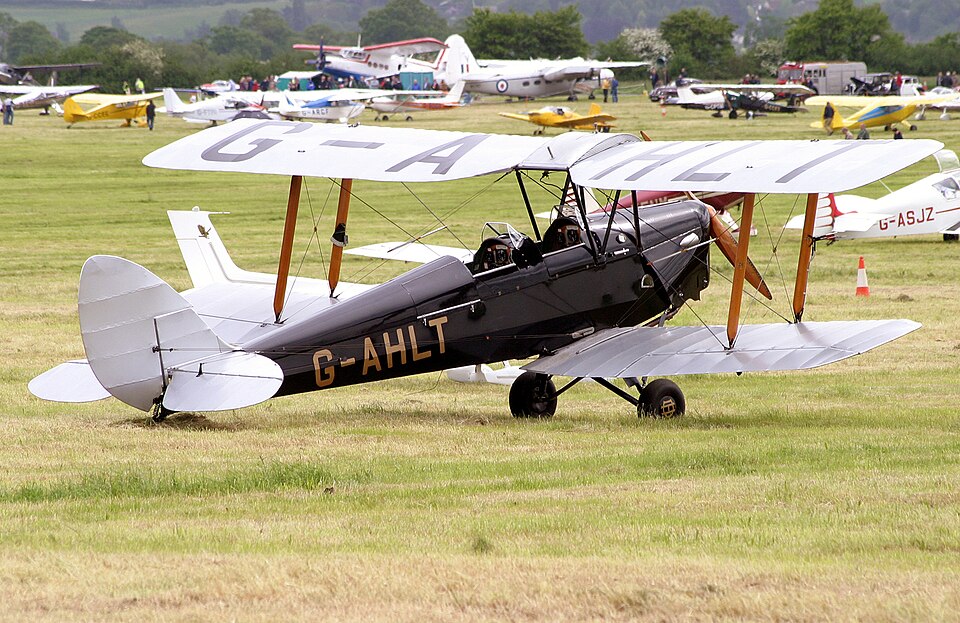
Accident Details
On 12 August 2012 at 1240 UTC, a DH82A Tiger Moth (registration G-AHLT, serial 82247, year of manufacture 1939) sustained damage during a landing attempt at a field near Mold, Flintshire. The aircraft was on a private flight with one pilot and no passengers. The pilot held a Private Pilot’s Licence, was 47 years old, and had 624 total flying hours (464 on type). The accident occurred 3 nm south-west of Mold.
History of the Flight
The pilot had identified the field as a possible landing site three years earlier. On the day of the accident, he flew a short positioning flight from a field a few miles south after obtaining landowner permission. He walked the field twice that morning and noted its challenging characteristics: a steeply sloping first half, a less steep second half, a total length of about 200 yards (183 m) with approximately 170 yards (155 m) useable. The landing direction was to the north. Obstacles at the far end included a small earth bank, a low fence, two trees, and power and telephone lines at about 50 ft. The pilot had measured the Tiger Moth's nil-wind landing roll on flat grass as 120 yards (110 m) and estimated it would stop within about 50 yards (46 m) accounting for the upslope.
After a successful multiple-leg tour of France (28 flying hours), the pilot felt confident due to recent flying practice. On arrival, he made a flypast to assess the site. Conditions were fine with light variable wind and 20°C. The first approach was abandoned because the aircraft was too fast. On the second approach, the airspeed was 55 mph, with the pilot intending to decelerate to 50 mph by the field's start (stall speed 45 mph). However, after crossing the hedge at the start, he realized the aircraft was too fast for a safe landing and too low to climb above the obstacles.
Landing and Go-Around
The main wheels touched down at the top of the steeply sloping section. Speed was above stall, causing the aircraft to bounce and then touch down again about 70 yards (64 m) before the end of the field. The pilot partially opened the throttle to maintain flying speed and fly between the trees. While concentrating on the gap between the fence and wires, the right wing tip struck tree branches. The pilot ducked and protected his head. He felt rolling sensations until the aircraft stopped, resting on its right side and pointing back toward its origin. He made switches safe, released his straps, and vacated the badly damaged aircraft.
Damage
The right side wings and tailplane were destroyed, and the propeller was destroyed. The pilot reported no injuries. In his report, the pilot noted the choice of landing site was not good and that he had not adhered to his own pre-flight plan to go-around if the approach was not entirely satisfactory.