History of the Flight
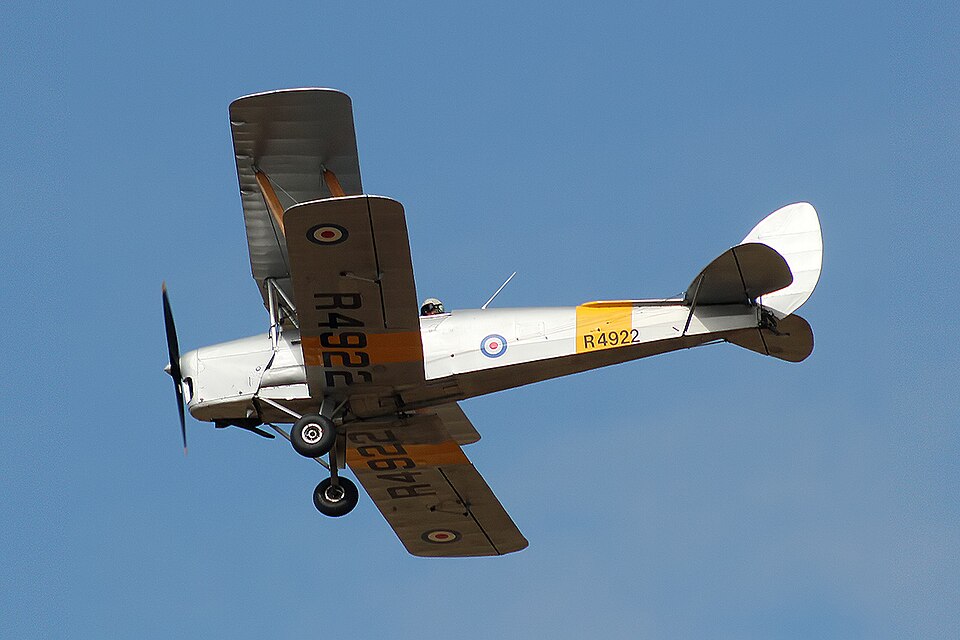
On 29 July 2004, a DH82A Tiger Moth (registration G-APAO) was conducting a training flight at Duxford Aerodrome, Cambridgeshire. The aircraft was part of a small fleet providing pleasure flights and instruction. The instructor, aged 35, held a Commercial Pilot's Licence with an Instructor rating and had accumulated 2,327 flying hours, including 115 on type.
One week prior to the accident, the instructor had been made aware that the usual grass runway was closed. He received a verbal briefing about a temporary grass runway, including its dimensions, and was told it was only available to his company. He discussed the restricted width with a colleague and agreed to reduce the crosswind limit from 15 kt to 10 kt for operations on that runway.
On the day of the accident, the instructor consulted the Terminal Aerodrome Forecast (TAF) for nearby London Stansted Airport, which predicted good visibility and light variable wind increasing to 160°/10 kt by 1400 hrs. He then undertook a training detail with a student and returned to land on temporary grass Runway 06, handling the aircraft himself. The approach was normal, but as the aircraft touched down, a gust of wind caused it to drift to the left. The instructor applied power to go-around and, aware of the presence of runway edge markers, maintained a three-point attitude to gain height rapidly. However, early in the go-around, with the aircraft still drifting left, the right main landing gear struck a ‘Tribox’ marker on the left edge of the temporary runway. The collision damaged the aircraft and caused it to decelerate, forcing the instructor to abandon the go-around. The aircraft ground-looped and came to a halt resting on the right wing tip, left landing gear, and tail. Both occupants vacated without injury. After the accident, the instructor noted that the hollow Tribox markers each contained water to approximately half their height.
Airfield Details
Duxford Aerodrome has two parallel runways 06/24: one tarmac and one grass. The permanent grass runway is 890 m long by 53 m wide. An open-air concert required erecting a large stage between the grass runway and aerodrome buildings, which infringed the protected area. In agreement with the CAA's Aerodrome Standards Department, a temporary grass runway was marked out, similar in length but 25 m wide (28 m narrower). It was agreed that the temporary runway should be marked in accordance with Civil Aviation Publication (CAP) 168, 'Licensing of Aerodromes'. The Aerodrome Standards Department does not provide specific guidance on marking temporary runways or equipment, but inspects aerodromes regularly for compliance.
Proprietary Tribox markers were purchased and placed at each runway end and along the sides. Recognising that they might be disturbed by propwash or jet-blast, the Aerodrome Fire Service was instructed to partially fill each hollow Tribox with water, though no specific amount was given. The aerodrome operator reported that the Triboxes could be moved 'fairly easily' by one man, even with water. A NOTAM was published stating the permanent grass runway was closed, and local arrangements gave the Tiger Moth operator use of the temporary runway, though no formal written briefing was provided.
The Tribox
The triangular Tribox, made of strong medium-density polythene, is 610 mm long, with 460 mm sides and 398 mm high. Individual boxes can be locked together via spigots. The manufacturer's website describes them as 'Bad ground markers' and states they are 'virtually indestructible', advising they can be partially filled with water for extra stability. By calculation, a Tribox containing water to half its height weighs approximately 40 kg more than empty.
Protection of Runways
CAP 168 defines a 'Runway Strip' as an area intended to reduce risk of damage to an aircraft running off the runway and to protect aircraft flying over it. One purpose is to protect aeroplanes during landing, balked landing, or take-off by providing an area cleared of obstacles, except permitted aids to navigation. CAP 168 instructs that aids to navigation within runway strips should be as light and frangible as possible. For marking unpaved runways, it specifies either flat rectangular markers flush with the surface (3 m long, 1 m wide) or frangible markers single-coloured, firmly secured, height not exceeding 36 cm, spaced at intervals not exceeding 90 m.
Frangibility
CAP 168 defines frangibility as the ability of an object to retain structural integrity up to a specified maximum load but to break, distort, or yield when struck by an aircraft, presenting minimum hazard. It provides no specific load values or tests. ICAO Annex 14 defines a frangible object as one of low mass designed to break, distort, or yield on impact. Interim guidance from ICAO (1991) proposes frangibility tests using a notional 3,000 kg aircraft: collision with wing in flight at 75 kt and with nose landing gear at 27 kt. The object is considered frangible if it breaks, deforms, or yields readily and the resulting damage to the impactor creates no hazardous condition.
Landing Gear Design
Standards (BCARs, JARs, FARs, EASA CS) require landing gear to withstand loads during normal ground operations, take-off, and landing; there is no specific requirement to withstand collision with ground objects.
Discussion
The aerodrome operator chose the Tribox without noting the CAP 168 height limit or assessing frangibility. The decision to partially fill with water contradicted the requirement for lightweight markers. The Tribox design, while intended for airfields, did not satisfy CAP 168 criteria for runway edge markers.