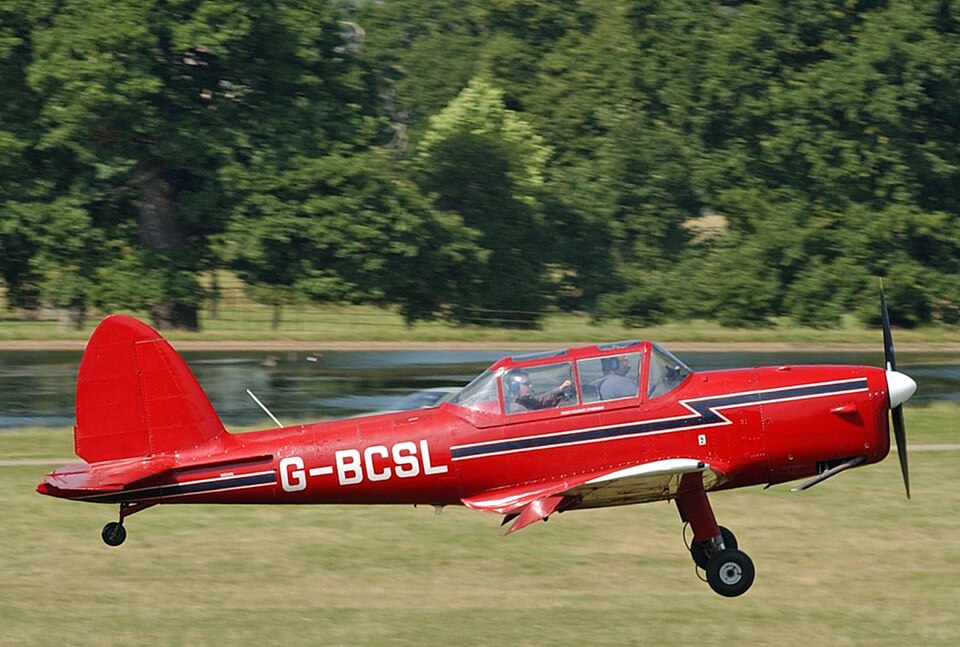
History of the Flight
The aircraft was parked outside a hangar facing the hangar door. The pilot started the engine, throttled back, and released the wheelbrakes with the intention of turning left. She applied left rudder to commence the turn but observed no effect. Attempting to use left wheelbrake to expedite the turn also proved ineffective. The aircraft continued moving slowly forward while the pilot continued applying brake and rudder. The propeller subsequently struck the hangar door, stopping the aircraft and its engine. Two bystanders assisted the pilot from the aircraft and switched off the magnetos and fuel supply.
Aircraft Taxiing Technique
The Chipmunk is equipped with a wide wheelbase, hand-operated wheelbrakes, and a castoring tailwheel that cannot be locked to the rudder. A lever on the right cockpit sidewall controls wheelbrake application; pulling the lever aft applies braking force. Differential braking is achieved by varying rudder pedal position while the brake lever is pulled. A finger-operated collar (latch) can lock the lever in a desired position. The standard procedure for taxiing involves releasing brakes, testing them symmetrically, then setting one pedal forward and locking the brake lever to create differential braking. The pilot's view over the nose is restricted, and frequent turns during taxi are recommended.
Engineering Investigation
A locally based company that had maintained the aircraft for several years conducted an engineering assessment after the accident. The investigation lasted 30 minutes and involved a Licensed Engineer and some of the aircraft's owners. No faults were found with the handbrake system, locking latch, or ratchet mechanism. The aircraft had flown approximately 30 hours in the month prior to the accident with no recorded defects. On the day of the accident, it had already flown once and had been parked by another pilot who reported that the wheelbrakes functioned normally.
Aircraft History
G-BCSL was owned by a large group and was well utilized during summer months. The accident pilot reported a history of intermittent wheelbrake problems, citing five separate events between January 1999 and June 2002. However, she had not been on board during any of these events and had not personally experienced brake issues on this aircraft. According to the person reporting the accident, none of these events had been recorded in the aircraft's documentation.
Analysis
The accident pilot attributed the collision to a completely ineffective combination of left rudder and left wheelbrake. However, no fault was found immediately after the accident. A spokesperson for the ownership group stated that the aircraft had been fault-free for the month before the accident and at the end of the preceding flight. The evidence is contradictory, with some indications pointing to pilot handling technique rather than a technical defect, while the pilot's account suggests a possible dormant intermittent fault. Owing to the passage of time, the AAIB could not verify the details. The report suggested that parking the aircraft facing away from solid obstacles such as hangar doors would be sensible, and that any recurring wheelbrake fault should be documented and resolved by qualified technicians.