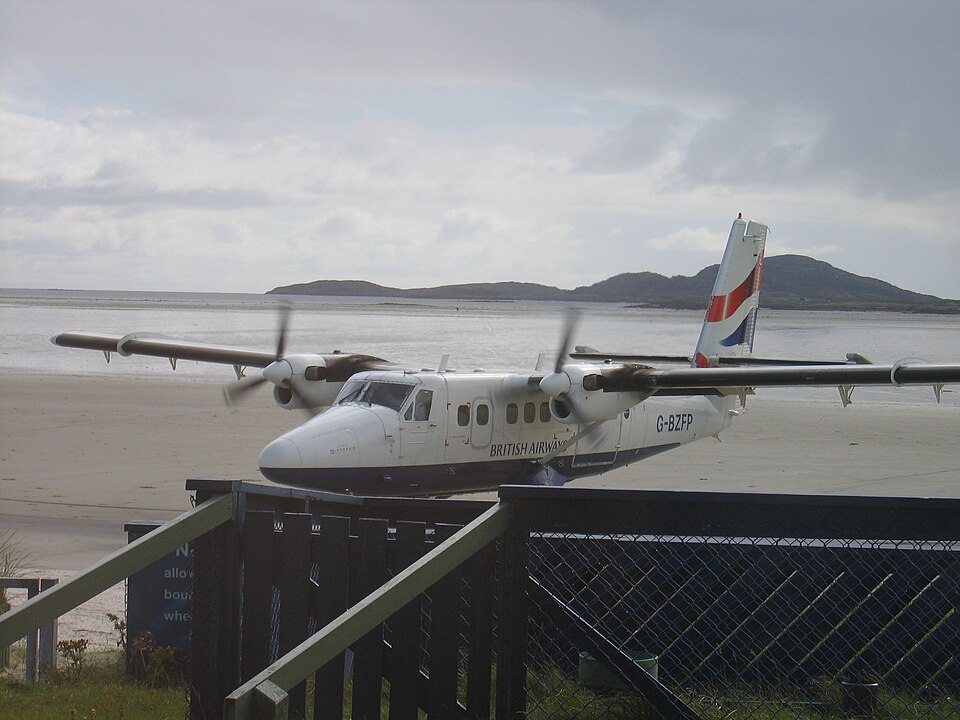
History of the Flight
After landing on Runway 09, the aircraft was initially directed to Stand 17. While taxiing behind two other aircraft, the crew were re-directed to Stand 22. During a left turn into Taxiway M, the lower section of the nose landing gear, including the wheel, detached from the oleo strut. The aircraft rapidly came to a standstill, resting on the projecting remains of the nose leg, with the underside of the nose making grazing contact with the ground. The crew informed ATC and requested the Airport Fire Service. After shutting down both engines, they were informed that there was no visible fire. No injuries were reported. Passengers left the aircraft via the rear airstairs, assisted by a fireman and the co-pilot.
Nose Landing Gear Description
The DHC-6 nose landing gear is a conventional design with a telescopic oil/gas oleo shock strut. The upper fixed section attaches to the fuselage via integral lugs. The lower sliding portion comprises a piston tube that engages a socket in the nosewheel fork, secured by a locknut. The locknut is a large diameter, externally threaded steel barrel with a shoulder at its lower end, inserted from below and engaging a female thread in the piston tube.
Aircraft Examination
Examination revealed that the fork section, complete with wheel, axle, and lower torque link arm, had detached from the lower end of the oleo strut. Secondary damage occurred to the lower fuselage. The lower torque link arm failed due to overstress. The operator conducted a detailed technical investigation of the failure, including maintenance activities.
Failure Investigation
The investigation found that the detachment resulted from corrosion damage to the screw threads of the locknut, causing threads to progressively disengage. Disassembly revealed a circumferential bead of sealant around the piston tube, indicating correct installation at time of assembly. A non-standard rubber disc was bonded to the underside of the fork fitting, covering the locknut head. The cap fitting that clamps the leg housing to the pillow block was installed upside down, allowing the torque link to foul. The lower torque link arm was stiff due to over-tightening of its pivot nut, and was corroded near its hinged connection.
Maintenance records showed that the nose landing gear assembly was overhauled in October 2003, including replacement of the lower torque link arm and fork. Over-tightening of the torque link pivot bolt likely occurred then. The rubber disc was fitted at that overhaul. In November 2006, the fork fitting was removed for steering collar thrust washer replacement, and during re-assembly the cap fitting was installed upside down.
Safety Action
The operator revised maintenance procedures: the aircraft's maintenance program now includes annual disassembly and inspection of the shock strut piston tube and locknut for corrosion. Wet assembly of the locknut using approved primer was approved by the manufacturer. The interval between torque link inspections was reduced from 2,400 to 200 hours. No non-standard parts like the rubber disc are permitted. The manufacturer was informed of the lack of guidance on correct cap fitting orientation. Due to these actions, no Safety Recommendations were made by the AAIB.