Accident Details
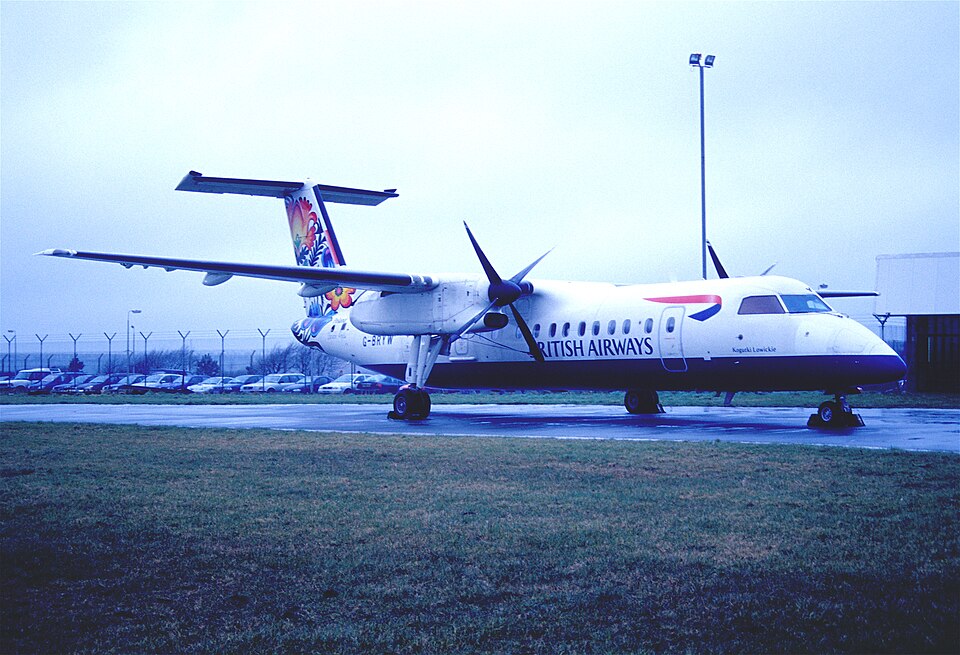
On 7 October 2005 at 1822 UTC, a DHC-8-311 Dash 8 aircraft, registration G-BRYW, was parked on Stand 8 at Aberdeen Airport with all 50 passengers and 4 crew on board. The engines had been started, and shortly after the Ground Power Unit (GPU) cables were disconnected, the GPU moved forward and struck the rotating propeller of the right engine before coming to rest against the fuselage. All occupants exited through the passenger door without injury.
Ground Power Unit
The GPU was a Houchin C762, manufactured in May 1997 and delivered to the operator in June 1997. It had recorded 13,471 operating hours at the time of the accident. The vehicle's primary controls included accelerator and brake pedals, a steering wheel, a hand-operated parking brake, and a forward-neutral-reverse selector lever. A service-idle switch on a panel behind the driver's seat inhibited drive in service mode and increased engine speed for power supply. A 10-second delay allowed engine speed to decrease when switching from service to idle before the vehicle could be driven.
Local Operating Practice
While the operator's Ground Operations Manual diagrams showed GPUs positioned facing away from the aircraft, local practice had evolved to position them facing the aircraft. This was done to keep exhaust fumes away from passenger walkways and to allow the headset operator to be visible from the GPU cab. No formal risk assessment of this practice was documented.
Sequence of Events
A three-man ground crew was tasked with dispatching the aircraft. One member positioned the GPU facing the right engine, applied the parking brake, selected service mode, and left to collect the push-back tractor. The other two crew arrived and started the right engine. The GPU operator noticed the engine noise was quieter than usual and the meter read 110 amps instead of 115; the flight crew noted 22.5V instead of 28V. The left engine was started successfully. The GPU operator then selected idle and began gathering power cables. Approximately 10 seconds later, the GPU moved forward unoccupied, striking the rotating propeller and then the fuselage. The flight crew shut down both engines and discharged fire bottles, then requested fire services from ATC. Passengers disembarked without incident.
Investigation Findings
No issues were found with the aircraft's serviceability or operation. The investigation focused on the GPU, revealing several maintenance issues:
- The governor rod connecting the fuel pump to the governor lever was found detached. The ball joint on the fuel pump lever was worn, allowing detachment with little effort. The fuel pump spring was also worn, causing the engine to run at moderate speed rather than idle when the rod detached.
- The forward-neutral-reverse selector's mechanical gate was worn, meaning the button did not need to be pressed to move the lever out of neutral.
- The parking brake was tested: with normal application (about four ratchet notches), it held the GPU on level ground at low engine speeds with forward selected, but not at moderate or higher speeds.
- Other defects included a near-side front tyre with exposed chords, corrosion on brake pipes, and worn pins and bushes on road springs.
Detailed Inspection
At the manufacturer's facility, the printed circuit board for the electrical safety system was bench-tested and found fault-free. It was concluded that the only way the vehicle could have moved was if the forward-neutral-reverse selector was in forward or reverse and the parking brake was either not applied or insufficient to hold at the engine speed present.
Damage
The aircraft sustained significant damage to all four blades of the right propeller and its hub, the right engine required a complete overhaul due to abrupt stoppage, and the fuselage suffered a dent with local structural damage. The GPU cab and engine cover were extensively damaged, with shattered windows and disrupted structural members. A propeller blade fragment was found on the driver's seat.
Recommendations
The AAIB made three safety recommendations regarding regulations for ground vehicles operating near aircraft, maintenance of the ground vehicle, and the manufacturer's servicing schedule.