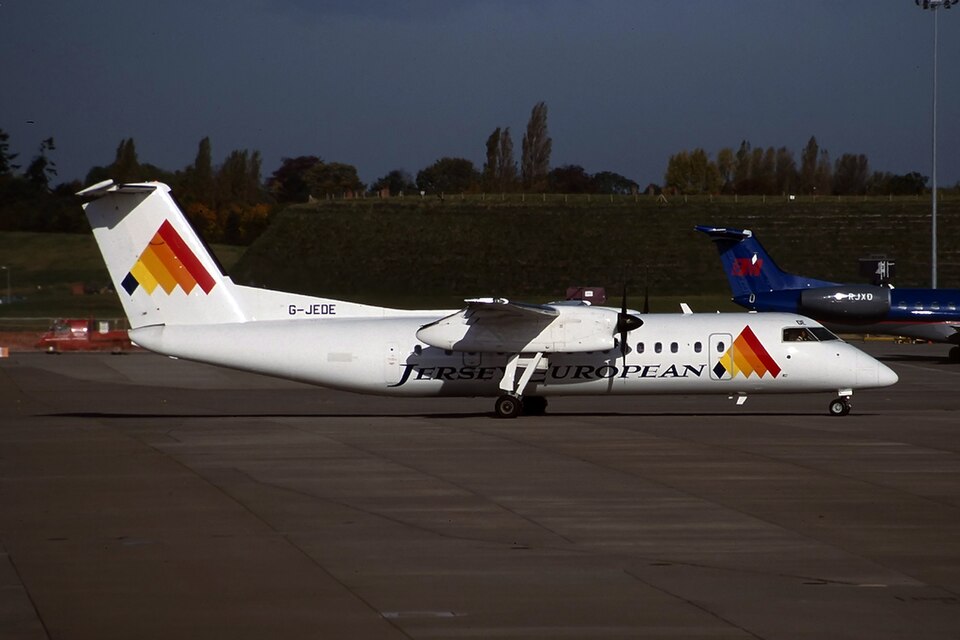
Incident Overview
On 29 November 2004, at 0914 UTC, a DHC-8-311 Dash 8, registration G-JEDE, operated by a public transport passenger service, experienced a tail strike during landing on Runway 10 at London City Airport (LCY). There were 3 crew and 32 passengers on board; no injuries were reported. The aircraft sustained damage to the skin of the fuselage in the tail section.
Flight History
The aircraft and crew were on their second of four scheduled sectors that day, from the Isle of Man to LCY. After an uneventful cruise, the first officer flew an ILS approach to Runway 10, which has a landing distance available of 1,319 metres. The 5.5° glidepath was intercepted from 2,000 feet and flown manually with landing flap (15°) set. At the ILS decision height of 430 feet, control was transferred from the first officer to the commander, as per company requirements. At handover, the airspeed was VREF +17 knots (108 knots). The commander then progressively reduced engine power, achieving VREF +5 knots before entering the flare. He maintained the 5.5° glidepath using precision approach path indicators (PAPIs). During the flare, the commander reported heavy "sink". Pulling back on the control column caused the nose to rise rapidly, and the first officer called "six degrees pitch" per standard operating procedures. The 'LDG ATT SIX DEG' message appeared on the advisory display. The first officer's call was not heard by the commander; almost simultaneously, a firm landing occurred. During rollout, the 'TOUCHED RUNWAY' red warning light illuminated.
Aircraft Damage
Examination revealed a light scrape mark on the aft underside of the fuselage near the tail-scrape detector. The white frangible plastic cover and the detector itself were completely abraded away. The freight floor above the detector area initially prevented internal access, but the damage was judged slight enough to permit a ferry flight for repairs. No control problems were reported during the ferry flight. Internal examination after removal of the freight floor confirmed no structural damage beyond the external skin. On the runway, a fresh white mark near the western threshold, parallel to the runway centreline, was identified as having been made by the tail-scrape detector cover. Fragments of the plastic were recovered. The mark was significantly closer to the threshold than the general touchdown area indicated by tyre marks.
Weather
The meteorological report at 0850 UTC described surface wind from 360° at 8 knots, good visibility, and little cloud. The crew reported little turbulence on the approach but considered that a recently glazed building north of the runway might have induced turbulence at the touchdown point. Other crews landing that morning did not report turbulence, though anecdotal evidence suggests turbulence occurs with stronger winds from the same direction.
Company Procedures
The company Operations Manual specified reducing speed to 120 KIAS before the final approach fix and maintaining it to decision height, then reducing to VREF. Procedures also stated that when conducting 5.5° approaches, the descent rate may require engine power to be maintained in the landing flare. Common practice, though not written, was to maintain VREF +5 knots until touchdown when runway performance was not an issue. Training emphasized stabilised power settings and tapering speed towards VREF after decision height.
Flight Recorder Data
The aircraft was equipped with a solid-state flight data recorder (FDR) and cockpit voice recorder (CVR). FDR data showed that at handover, 450 feet above ground, the aircraft was on glide slope at 108 knots (VREF +17) with a descent rate of 1,100 ft/min and reducing torque. After handover, torque decreased further to a minimum of 3.5% and 2% over ten seconds. A 4° nose-up pitch change occurred as descent rate slowed to 900 ft/min. Ten seconds before tail strike, torque began increasing but only reached 10% and 7% at strike. Four seconds before strike, a large elevator deflection to 60% caused a nose-up pitch rate of 5°/second, reaching a maximum pitch attitude of just under 9°. Airspeed at tail strike was 91 knots (VREF). Nose gear touched down four seconds after tail strike at 80 knots.
Analysis
FDR data indicated that at handover the aircraft was 12 knots slower than company SOPs specified. The commander reduced engine torque to an unusually low level to decelerate to VREF quickly. Comparison with other landings showed this was the only case of significant torque reduction after handover. The low power destabilised the final approach; torque never reached normal levels. This low power, combined with airspeed near VREF, gave the aircraft less energy approaching the flare. Without a significant power increase, the pitch angle had to increase rapidly to reduce descent rate, resulting in the tail strike. Company SOPs called for deceleration from 120 KIAS at decision height to 91 KIAS at touchdown on a 5.5° approach, which was difficult to achieve while maintaining a stabilised approach. Analysis of other landings showed commanders often flew stabilised approaches with higher touchdown speeds. There was anecdotal evidence of the commander's airspeed indicator over-reading, possibly leading to higher landing speeds. The landing distance available at LCY posed no performance issues if touchdown was at the correct point, which may have encouraged acceptance of higher speeds. The company's advice to maintain engine power in the flare was significant for reducing sink without large pitch increases. Although the commander suspected wind effects from nearby buildings, the low wind speed made this unlikely. The airport's proactive stance on future building development and wind assessments was noted.
Follow-up Actions
As a result of the incident, the commander received three days of line training with a company type rating examiner and was released back to line flying. For reasons unconnected with this incident, the company no longer operates this type of aircraft and has withdrawn all operations from LCY.