Background
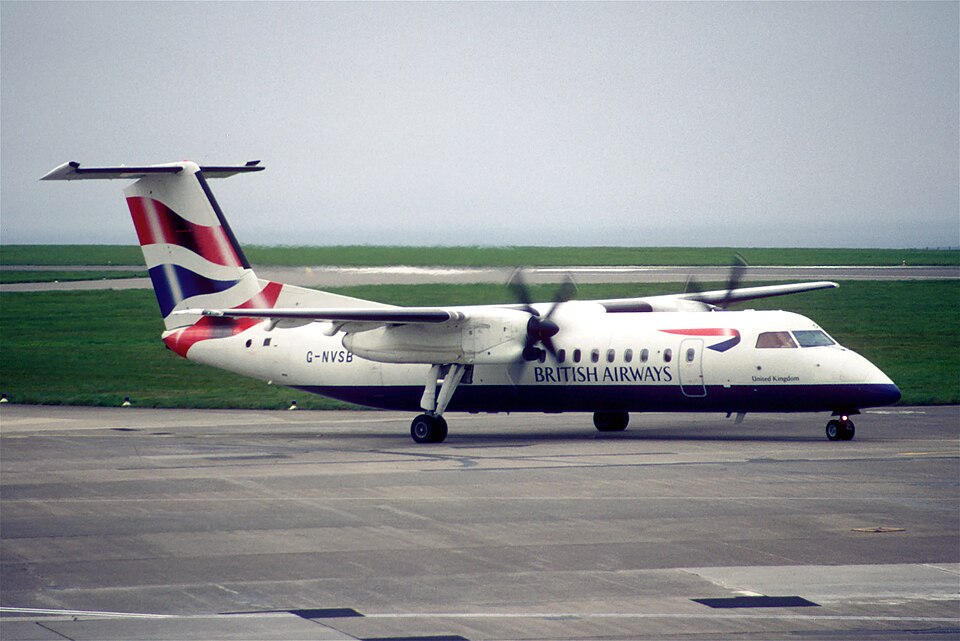
The aircraft, a DHC-8-311 Dash 8 registered G-NVSB, was operated on a public transport flight. The flight crew consisted of a senior captain with 17,500 hours total (1,200 on type) and an inexperienced co-pilot who had commenced line flying five months earlier. The incident occurred at 0930 UTC on 24 March 2005, 5.7 nm west of Isle of Man (Ronaldsway) Airport. There were 4 crew and 20 passengers on board; no injuries were reported and no damage was sustained.
History of Flight
The crew was flying a visual approach to Runway 08. The glide slope for the ILS was temporarily unavailable. The co-pilot, acting as handling pilot, attempted to brief the commander on the expected LLZ/DME approach, but the commander indicated a brief was unnecessary. A visual approach was not discussed. After being vectored by ATC, the co-pilot announced he was "visual," and the commander requested a visual approach, which ATC approved.
Co-Pilot's Account
During the downwind leg, the co-pilot called for initial landing checks, but the commander lowered the gear and selected landing flap without consulting him. The commander also retuned the navigation receivers from LLZ/DME to Isle of Man VOR/DME and placed the flight director in standby. The co-pilot commenced a descent after initiating the final turn but lost visual contact with the airport, attributing this to distraction and haze. The aircraft flew through the runway centerline, and the commander informed ATC. The commander made right aileron inputs but did not assume control; the co-pilot surrendered control without verbalizing. The EGPWS issued a "TERRAIN" warning followed by a "PULL UP" hard warning. There was a delay, and at least one further warning occurred. The commander announced a go-around.
Commander's Account
The commander reported that the co-pilot gave a good briefing. Weather was good, and early visual contact was made. The commander asked if the co-pilot wanted to fly a visual approach, and the co-pilot agreed. The commander did not retune the navigation aids; he believed both receivers were set to VOR/DME. The aircraft began a visual downwind leg at about 3,000 ft. The commander twice prompted the co-pilot to descend and turn finals, but the co-pilot seemed reluctant. The commander decided to let the co-pilot extend the downwind leg while losing height. He was aware of the aircraft's position and was content to continue the descent over the sea. As the final turn neared completion, the commander realized how low the aircraft was. He saw high ground ahead and believed clearance of 300-400 ft. The gear was not yet lowered. He heard an EGPWS "TOO LOW - GEAR" alert, took control, called for gear and flap 15, and slowed the aircraft. Then a "PULL UP" hard warning prompted a gentle climb, then a go-around due to concern for passengers.
EGPWS Warnings
Recorded data from the EGPWS memory showed the first hard warning occurred at 680 ft amsl, 115 kt, heading 139°(M), descending at 730 ft/min, with gear down and flaps in landing configuration. The aircraft was 5.7 nm from the runway, heading toward high ground (573 ft elevation) 1.3 nm ahead. It descended to 650 ft before leveling off and climbing slightly.
Other Witness Information
A company flight crew member traveling as a passenger reported that the aircraft turned at about 5-7 nm from the airport, crossing the runway centerline on a southeasterly heading, and descended abnormally low. The EGPWS warnings were audible in the cabin.
Aerodrome Information
Isle of Man Airport's Runway 08 approaches pass over terrain reaching 573 ft amsl at 4.6 nm from the airport, where the VOR/DME is located. Minimum Safe Altitude within 25 nm southwest is 2,600 ft amsl.
Recorded Information
Flight Data Recorder and Cockpit Voice Recorder data were overwritten. The EGPWS memory provided limited but valuable data; warnings were determined to be legitimate.