History of Flight
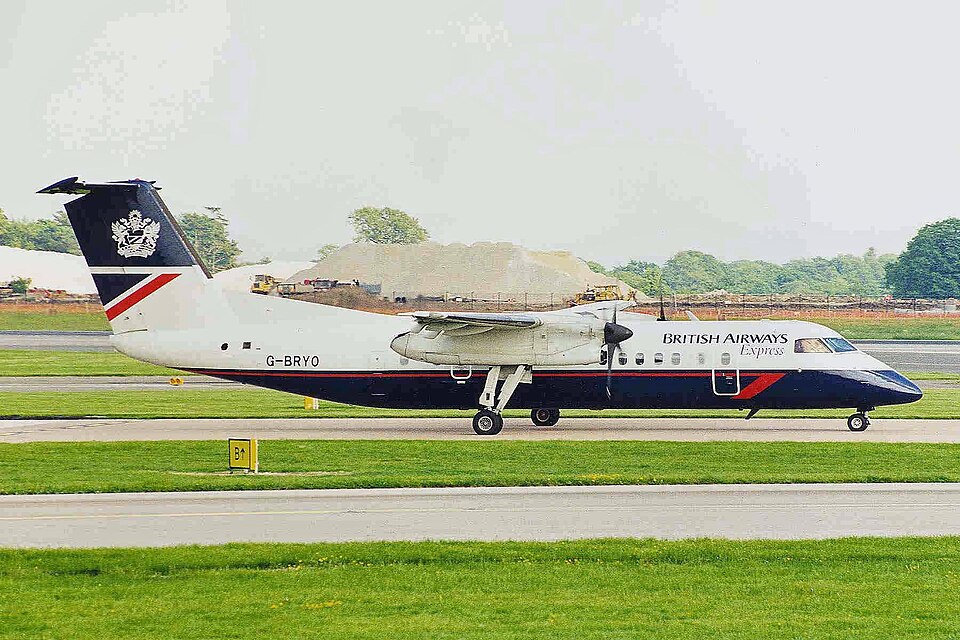
On 1 March 2001 at 1845 UTC, a de Havilland Canada DHC-8-311, registration G-BRYO, was operating a public transport flight. The crew was on the fourth sector of a seven-sector day, flying from Newquay to Plymouth. The first officer, undergoing line training, was the designated pilot flying from the right seat. The commander, a training captain, occupied the left seat. An additional first officer was seated in the cockpit jump seat for observation.
The flight from Newquay was uneventful, cruising at 2,500 feet. The pilot flying joined the left downwind for Runway 31 at Plymouth. During the base leg, the first officer lost sight of the runway, and the commander assumed handling. Shortly after, the first officer reacquired the runway and resumed control. The aircraft was configured with flap 15 on the 3.5° ILS glideslope.
The jump seat pilot observed the Precision Approach Path Indicators (PAPIs) showing three white and one red, indicating the aircraft was above the glideslope. The commander called "high," and the first officer corrected. A second deviation occurred and was corrected. Airspeed remained around 120 kt, with Vref set at 103 kt. As the aircraft approached the threshold, the commander twice instructed the first officer to "flatten the approach." The first officer flared and touched down at the normal point. The landing was firm. Shortly after touchdown, the red "Touched Runway" warning illuminated. The jump seat pilot reported seeing the white "LDG ATT 6 DEGREE" light momentarily. The commander taxied to the parking stand, where damage to the underside of the rear fuselage was confirmed.
Airfield Information
Plymouth Airport was designated a Category 'B' airfield by the operator, requiring prior briefing for pilots. Runway 31 has a landing distance of 1,055 metres from the threshold, 905 metres from the glideslope, a width of 30 metres, and an upslope of 0.95%. The PAPIs were set at 3.5°. All approach and runway lights were serviceable and illuminated.
Crew Information
The first officer joined the company in November 2000, completed simulator training in January 2001, base training on 12 February, and began line training on 20 February. The incident occurred on his 19th line sector. He had 200 total flying hours, with 23 hours on type. The commander, aged 56, held an Airline Transport Pilot's Licence and had 14,028 total hours, including 541 on type. The two pilots had operated together for two consecutive days; the first officer had been debriefed on his performance. An earlier landing at Plymouth the previous day was debriefed, noting insufficient flare and drift correction.
Aircraft Damage
Damage extended over an area 24 inches wide by 49 inches long on the underside of the rear fuselage. The frangible switch for the "Touched Runway" caption and its fairing were damaged. Minor internal damage to skin flanges of frame X642 occurred. Repairs were completed by the manufacturer.
Discussion
The aircraft was serviceable except for a fault in the Flight Data Recorder (FDR), which prevented data recovery. Cockpit Voice Recorder (CVR) recordings confirmed crew recollections and indicated operations in accordance with company procedures. The commander provided appropriate guidance. On final approach, the commander advised the first officer about being high on the glideslope and instructed him to "keep it going down." Prior to touchdown, he directed "flatten it out." No evidence of a hard landing was noted on the CVR.
The first officer's limited experience and previous debriefing may have contributed to unease. During the circuit, he lost sight of the runway, prompting the commander to take over. When the first officer resumed handling, the aircraft deviated from the glideslope twice. Discussions suggested that the first officer's focus on the glideslope may have led to power lever retardation without subsequent advancement. Neither the commander nor the jump seat pilot considered the landing abnormal, and both were surprised by the "Touched Runway" warning.
While this could be considered a training incident, the DHC-8-300 series is known for critical landing attitudes. The manufacturer and national authority agreed to produce a training video addressing fuselage strikes. No safety recommendation was deemed necessary.