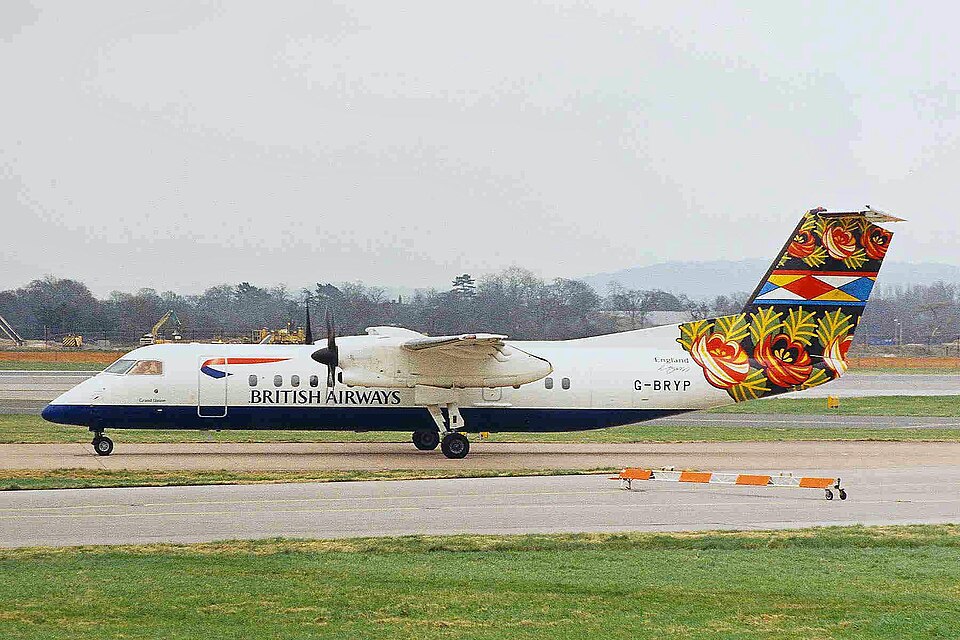
History of the Flight
The crew reported for duty at 0930 hrs at Bristol Airport. The commander, aged 44 with 11,750 total flight hours (4,800 on type), and the first officer, with 1,040 hours (750 on type), agreed that the first officer would handle the first two sectors due to expected deteriorating weather. The flight to Plymouth departed at 1045 hrs. At 1053 hrs, the commander contacted Plymouth ATC, who advised Runway 31 in use with surface wind 240°/16 kt gusting to 26 kt.
During descent, the commander noted wind approximately 30 kt between 1,500 and 1,000 ft agl. At 1115 hrs, the aircraft was established on the ILS. The commander reminded the first officer to advise if uncomfortable. The crew used the crab technique transitioning to wing-down for landing. The aircraft was fully configured by 1,000 ft agl.
Approach and Touchdown
The first officer maintained 130 kt early in the approach, reducing to Vref +10 kt by the threshold. Conditions were blustery. Upon flare, the aircraft suddenly lost height, and the left gear contacted the runway, followed by right and nose gear. The aircraft began tilting left; the commander took control but could not correct the bank. The aircraft came to rest left wing low after a ground roll of approximately 340 metres.
ATC described the landing as "heavy" and saw the left gear fold rearward. Emergency services were alerted. Within the aircraft, cabin attendants noted acrid smoke and initiated evacuation. All nine passengers and four crew evacuated safely. The fire service applied foam; a Breathing Apparatus team found no fire.
Recorded Information
CVR and FDR data were recovered. The ILS approach was flown with autopilot until 1,000 ft agl, then manually. Moderate turbulence was recorded (normal acceleration 0.58g to 1.35g). From 440 ft, increasing right rudder and left aileron were used, with average 4.5° left wing down. At 200 ft, two glideslope warnings activated as the aircraft descended below the glidepath; power was increased to regain the profile.
During the last five seconds from 80 ft, airspeed varied between 109.5 and 98 kt, roll up to 6.2° left wing down. Power was reduced at 34 ft, and up elevator applied. From 27 ft to 16 ft, normal acceleration dropped to 0.62g, indicating increased descent rate. Just before impact, over 16° up elevator was applied. Average descent rate was 500 ft/min, but the last half-second rate was approximately 1,800 ft/min. Last recorded values: pitch 3.4° nose up, roll 6.2° left wing down, airspeed 103 kt.
Four seconds after touchdown, roll increased to 8° left wing down, left propeller speed dropped to 700 RPM, and propeller strikes were audible. Maximum right aileron was applied before the aircraft stopped at 10° left wing down after 15.5 seconds.
Engineering Investigation
Extensive damage was found to the left propeller blades and aft fuselage from abrasion. The left main landing gear was folded rearward against the closed doors. The acrid smoke was traced to insulation material heated by friction with the runway; it self-extinguished after the aircraft stopped.
Probable Cause
Not determined from the available information.