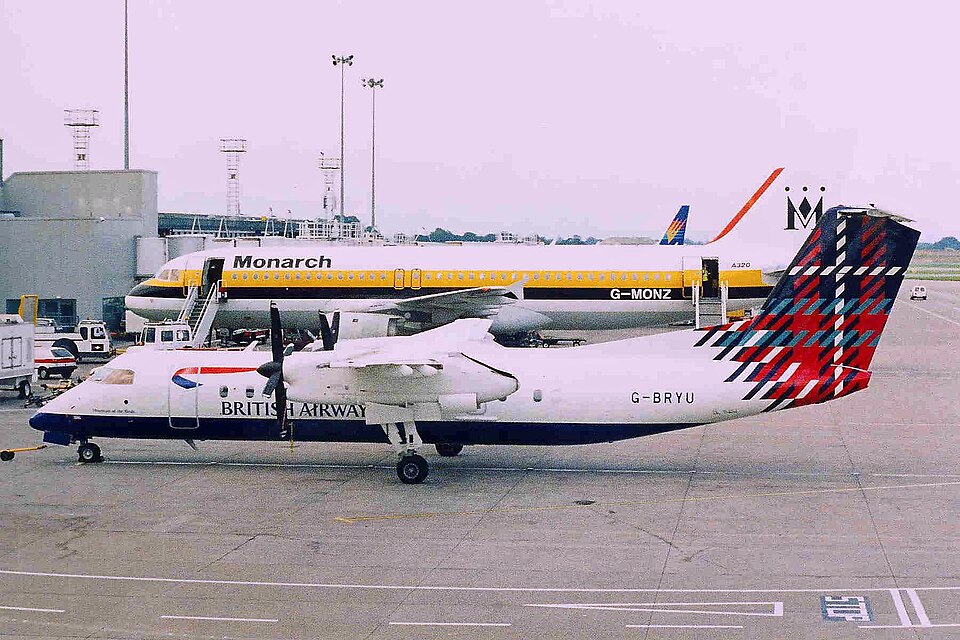
Incident Overview
On 20 June 2005, at approximately 1340 UTC, a de Havilland Canada DHC-8-311, registration G-BRYU, was involved in an incident at Aberdeen Airport, Scotland. The aircraft, equipped with two Pratt & Whitney Canada PW123 turboprop engines, had just completed a public transport passenger flight. On board were four crew members and 28 passengers.
Sequence of Events
As passengers were disembarking, a member of ground staff gestured towards the nose area, indicating an abnormality. The commander left the aircraft to investigate and observed what appeared to be smoke emanating from a vent under the right-hand side of the nose. By the time he returned to the aircraft, all passengers had disembarked. The commander re-entered the cockpit, instructed the First Officer to alert the Airport Fire and Rescue Service (AFRS) and then to evacuate the aircraft. He then entered the cabin, advised the cabin crew to evacuate via the forward exit, and ensured all electrical power was removed from the aircraft before departing.
Response and Investigation
Upon arrival, the AFRS determined that the smoke had ceased, and no extinguishing agent was used. An engineer, accompanied by the fire services, conducted an investigation. Examination revealed that a very small hole in a hydraulic pipe had sprayed fluid onto the hot area of the weather radar, producing a fluid vapour that resembled smoke. The hole was presumed to have resulted from chafing or fretting due to contact with adjacent structure or piping.
Operator's Follow-Up Action
Around the time of this incident, the operator identified a high occurrence rate of hydraulic leaks across its Dash 8 fleet. Consequently, an Engineering Technical Requirement was issued calling for "Inspection of Rigid and Flexible Hydraulic Tube Installation." The inspection specifically involved checking the installation of all rigid hydraulic tubes in the nose landing gear bay, left and right nacelles, wing roots, and rear fuselage for adequate clearance between pipe-to-pipe and pipe-to-structure. Additionally, the installation of main landing gear brake unit flexible hydraulic tubes was to be inspected. This inspection was repetitive and scheduled at 'A' and 'C' checks. In the six months following implementation, only one further hydraulic leak was reported on the operator's Dash 8 fleet, which comprised eight aircraft. This represented a substantial reduction compared to the previous rate of occurrence.
Injuries and Damage
No injuries were reported among the crew or passengers. The nature of damage was limited to a hydraulic pipe leak.