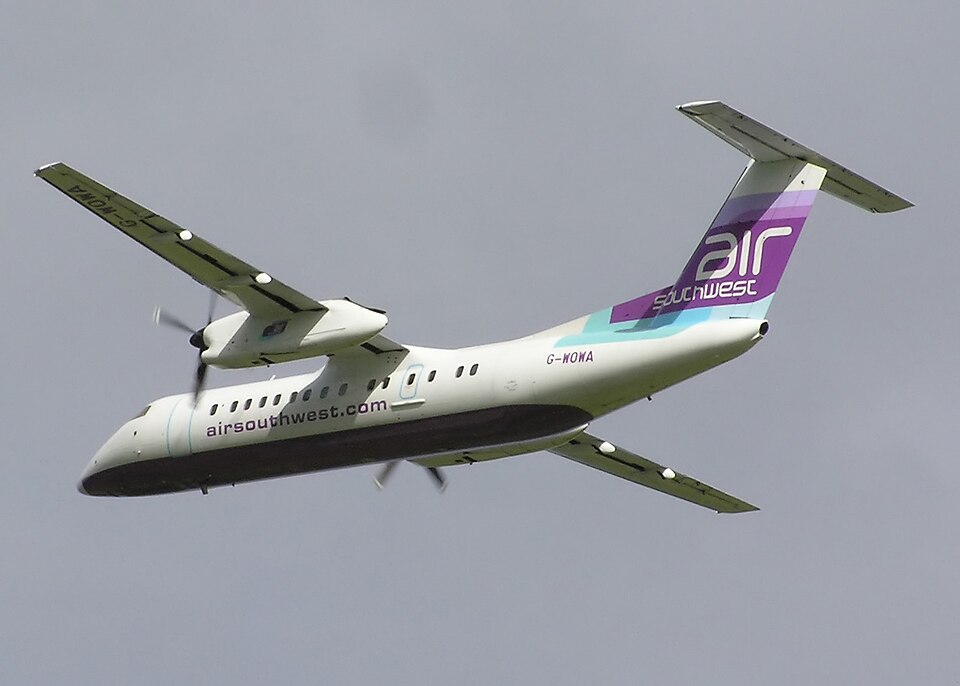
History of the Flight
The DHC-8-311, registration G-WOWA, was operating a scheduled passenger service from Dublin Airport to Newquay (Cornwall) Airport. The aircraft departed Dublin at 1225 UTC with 51 passengers and three crew members. The commander acted as the handling pilot for the flight. Initially, the crew received radar vectors before flying a visual approach to Runway 12 with flaps set to 15°. The landing was uneventful until the approach phase.
Meteorological Conditions
A strong south-south-westerly airflow prevailed ahead of a cold front moving at 40 to 55 kt. The forecast issued at 0730 indicated a surface wind from 200° at 15 kt gusting to 25 kt, increasing to 25 kt gusting to 38 kt. The 0750 weather report for Newquay showed a southerly wind of 16 kt. After landing, ATC broadcast a surface wind of 25 to 30 kt with a recent gust to 36 kt. There was overcast cloud at 2,100 ft, with smaller amounts at 1,200 ft and 700 ft. A strong, gusty south-westerly surface wind blew directly across the runway, causing moderate turbulence on approach. The commander reported a target approach speed of 10 to 15 kt above the calculated Vref to account for gusts.
Aircraft Information
The landing mass was 41,649 lbs, 349 lbs below the maximum permitted landing mass. At this mass, Vref with flaps at 15° would have been 108 kt. Operator standard operating procedures required adding half the steady wind speed plus the full gust factor to Vref, with a maximum additive of 20 kt. Landings are normally made with flaps at 15°, though 35° is used for short runways. With flaps at 15°, the maximum acceptable wind from the reported direction was 31 kt. Aircraft technical publications warned that a tailstrike could occur if pitch attitude exceeded 6° during landing.
Recorded Data
Quick Access Recorder data showed the aircraft initially descended to about 2,300 ft, then to 1,300 ft (approximately 1,000 ft above aerodrome level). After 30 seconds, it commenced a final descent at 200 to 300 ft/min. At about 800 ft, it crossed the coastline, then descended at 600 to 700 ft/min, equating to a 3.4° approach angle. During the latter stages, speed remained at or above 118-123 kt (Vref+10 to +15 kt) with pitch attitude between 2° and 3°. From about 16 seconds before touchdown, pitch excursions increased despite corrective elevator inputs. Two significant pitch excursions occurred at 6 and 2 seconds before touchdown. The first reached a maximum of 10.5° at a radio altitude of 24 ft, even after a nose-down elevator input. The pitch then reduced briefly to 2-3°, before increasing again to 10.6° at 11 ft. During the first excursion, airspeed dropped to 105 kt (Vref-3 kt), then recovered somewhat before trending downward. At the peak of the second excursion, airspeed reached 94 kt (Vref-14 kt). Touchdown occurred with a pitch attitude of 2-3° and decreasing at about 5° per second, at an airspeed of 98 kt. Peak normal acceleration at touchdown was 1.2 g, lower than during the two pitch excursions (1.4 g). Engine torques increased in response to airspeed loss. Maximum torque below 100 ft was 31.2%. Pitch trim varied between 2.7 and 3.8 units, stabilizing at 3.1 units in the final 200 ft.
Discussion
The flight data indicated a stable approach initially, which became unstable at a late stage, probably due to a combination of gusty conditions and associated large control inputs. During the final stage, airspeed decayed to 94 kt, significantly below both Vref and the target approach speed. The commander reported a significant downdraught below 100 ft, likely associated with the pitch excursion at about 24 ft and subsequent airspeed loss. Although engine thrust was added, it was not effective. The second pitch excursion, shortly before main wheel touchdown, was when the tail most likely contacted the runway. The commander did not recall an exaggerated pitch attitude at touchdown, which the data supported, as touchdown pitch was 2-3°. A caution light indicated pitch attitude exceeding 6°, and the TOUCHED RUNWAY warning illuminated during the landing roll, confirming contact. Minor damage occurred: the frangible fairing on the ‘touched runway’ sensor broke, and the underside of the rear fuselage sustained light abrasion.