Aircraft and Flight Details
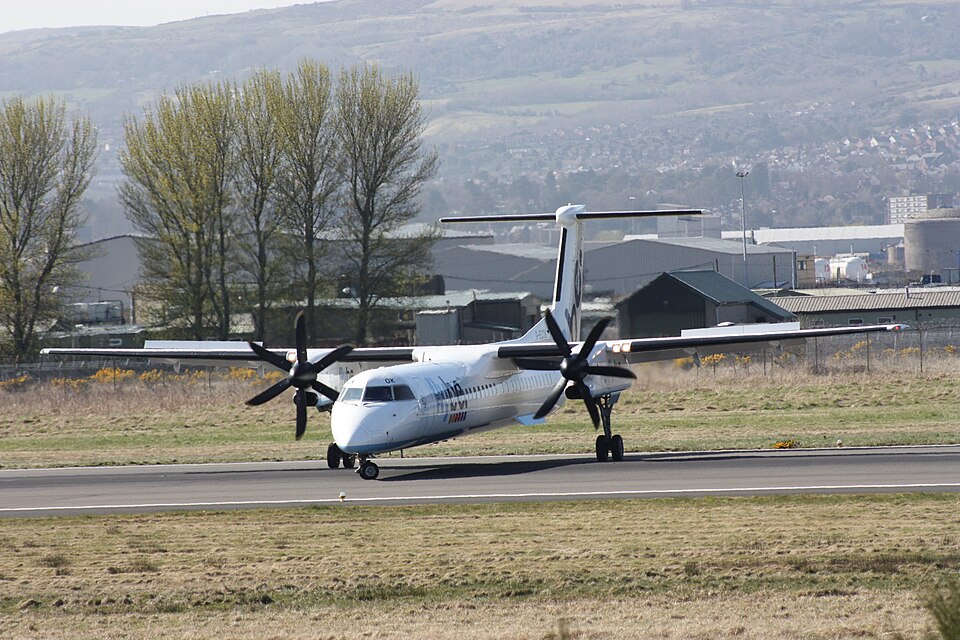
The aircraft involved was a DHC-8-402 Dash 8, registration G-ECOK, equipped with two Pratt & Whitney Canada PW150A turboprop engines. It was manufactured in 2008 (serial number 4230). The flight was a commercial air transport passenger service. On board were 4 crew and 46 passengers. No injuries were reported, and no damage was sustained.
History of the Flight
The incident occurred on 16 November 2011 at 1300 UTC, approximately 8 nm north-east of Manchester Airport. The crew reported for duty at their Manchester base between 0610 and 0615 hrs. Their initially planned roster was changed to a four-sector duty: a return flight to Norwich and a return flight to Knock. The aircraft departed ahead of schedule but was unable to land at Norwich due to poor visibility, so it returned to Manchester before operating the flight to Knock. The incident occurred on the return flight from Knock during the approach to Runway 23R.
The aircraft was being flown by the right-hand seat pilot, who was a Training Captain acting as First Officer following a roster change. The commander was the left-seat pilot. The right-hand pilot intended to fly the approach manually with the flight director for practice. The reported visibility at Manchester was 3,900 m in haze, with light and variable wind and scattered cloud at 800 ft aal.
Manchester ATC vectored the aircraft onto an intercept heading for the localiser (ILS QDM 234°) and descended to 2,500 ft. The acting First Officer armed the flight guidance approach mode. As the localiser deviation indicator moved from full-scale deflection, the flight guidance localiser and glideslope capture modes engaged automatically. The acting First Officer followed the 'turn right' flight guidance indicators and commenced descent along the glideslope.
The crew were aware the aircraft was to the right of the localiser centreline due to a 'fly left' indication. Suspecting a false localiser capture, they selected heading and vertical speed modes while continuing descent. The acting First Officer steered left to recapture the localiser and re-armed approach mode. He then observed conflicting localiser deviation indications: his side showed 'fly right', while the commander's side showed 'fly left'. Using the Multi-Function Display navigation page, they determined the aircraft was still to the right of the actual localiser centreline.
The acting First Officer stated they would execute a go-around at 1,000 ft aal if not correctly established on the localiser. At about 1,300 ft, Manchester ATC asked if they were visual with the approach lights. The crew were not, though they had visual contact with the ground and recognised significant features in the approach area. They advised ATC and were instructed to go around.
During the vector for a further ILS approach, the crew noticed a discrepancy on the flight guidance control panel: the left side inbound course was set to 265° (likely unchanged from the approach at Knock, which has a localiser QDM of 265°), while the right side was set to 234°. The left side was then set correctly, and the second approach was completed using the autopilot without incident.
Recorded Information
Data from the aircraft's quick access recorder (QAR) was analysed. It showed the aircraft descending on a steady intercept heading of about 200°(M) when localiser and glideslope capture modes engaged. The aircraft was slightly above the glideslope but correcting. At localiser capture, deviation was just over two dots (about 2.5°) and reducing. The selected heading was moved to 234°, but the aircraft continued turning right until reaching about 255°. Deviation reduced to one dot 'fly left' then increased to full scale as the aircraft flew away from the localiser centreline.
Heading slowly reduced to slightly less than the inbound course, at which point heading and vertical speed modes were selected and a heading of about 210° set at about 2,000 ft aal. Localiser and glideslope capture modes were re-engaged at about 1,700 ft, with an almost identical pattern: deviation reduced to one dot then increased to full scale. As deviation exceeded two dots, the aircraft was descending through 1,400 ft heading about 250°. When go-around mode engaged at about 1,050 ft (800 ft aal), localiser deviation was full scale 'fly left'.
Recorded data showed continuous agreement between localiser deviation values for both left and right ILS receivers. Radar data correlation confirmed good agreement between aircraft position and indicated deviation.
Operator's Investigation
The operating company's investigation noted the two pilots worked effectively together, though the acting First Officer was senior by virtue of his Training Captain status. The crew retained sufficient situational awareness to determine they were off track, but this may not have been aided by the miss-set course on the commander's side. The operator also noted that crew capacity to handle the problem may have been enhanced if the autopilot had been engaged.
It was established that the crew deviated from standard operating procedures by continuing descent without correct localiser establishment. The operator conducted a simulator exercise to explore the effect of the discrepancy in selected inbound courses; results suggested that while localiser deviation indications should not be affected, it may have caused the flight director to function inefficiently at the point of localiser intercept.
The operator reported several false localiser capture incidents affecting its Q400 fleet, more than half at Manchester. Internal investigations were ongoing, though the operator felt this incident was more probably a case of the flight guidance system not following the localiser as expected rather than an actual false capture event.
Safety Actions
The operator's report made three internal safety recommendations. A Notice to Crew was issued warning against starting final descent before the aircraft was confirmed established on the correct localiser. It also stressed the importance of discontinuing an approach if inconsistent localiser indications are observed. An appropriate cross-check was introduced prior to the localiser intercept point to address potential flight director impairment due to a miss-set selected course.