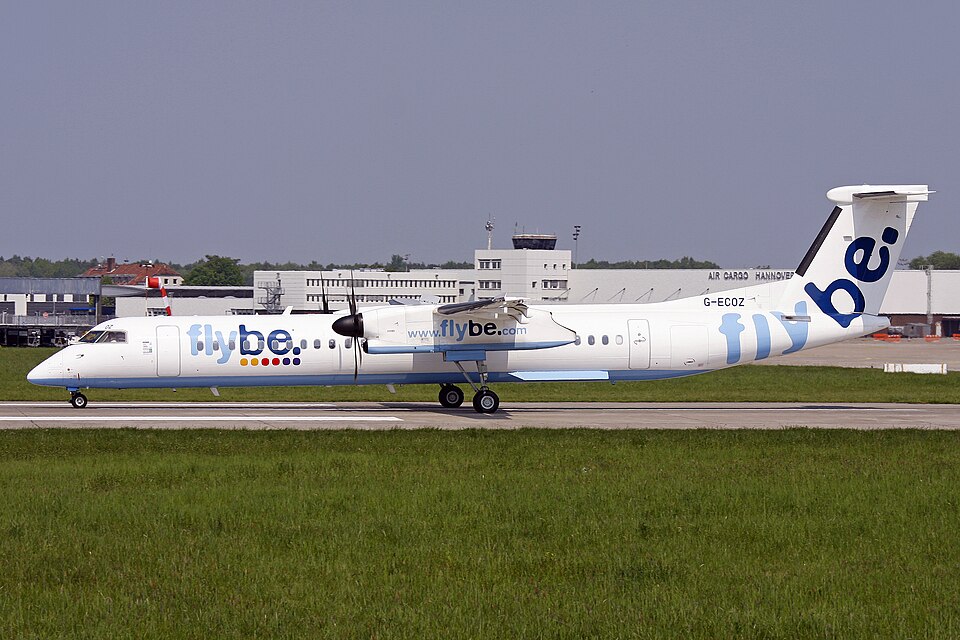
History of the Flight
The aircraft was operating the first sector of a return flight from Newcastle to London Gatwick. The commander was the pilot flying, and the crew were aware of forecast strong and gusty wind conditions. The approach was a standard operating procedure Flap 15 ILS approach to Runway 08R. The automatic terminal information service (ATIS) reported wind as 170°/17 kt with direction varying between 140° and 210°, less windy than expected.
During the approach, the aircraft experienced significant variations in airspeed due to turbulence. The commander elected not to use reduced propeller RPM and selected max governing RPM for rapid speed response. At about 700 ft above ground level, the autopilot disconnected due to turbulence. The commander stabilized the aircraft manually with a target Vref of 120 kt. At 500 ft, the aircraft was cleared to land with surface wind 190°/12 kt gusting to 24 kt.
At 300 ft agl, the commander was visual with the runway. The aircraft descended slightly below the glideslope, and the commander added power to recover. At about 40 ft agl, airspeed increased to 137 kt; the commander reduced torque to 8%. Speed decreased to Vref, but the rate of descent initially remained at about 600 fpm. At 25 ft agl, the commander became aware of an increasing sink rate and initiated a flare, increasing pitch from 2.5° to 7.5° over three seconds. The flare did not arrest the descent, and the aircraft touched down heavily on both main gear and the aft fuselage.
The touched runway caption illuminated after landing. The crew performed the emergency checklist and taxied to the parking stand. Passengers disembarked normally.
Recorded Information
The aircraft was equipped with a digital flight data recorder and cockpit voice recorder, both successfully downloaded. Pertinent data is included in the history.
Meteorological Data
The UK Met Office provided an aftercast showing low pressure to the north and west of Gatwick, with strong south to south-westerly flow. A frontal band with heavy rain and embedded cumulonimbus was present. The 0950 UTC METAR recorded surface wind 170°/13 kt with gusts of 23 kt. The estimated 2,000 ft wind was 220°/60 kt, indicating potential for severe windshear-induced turbulence.
Structural Damage
The fuselage lower skin was extensively abraded over a region straddling the centerline, extending 2.25 m longitudinally and 0.75 m laterally. Fuselage frames were deformed, and the skin was fully penetrated by abrasion.
Runway Damage
A scrape mark about 2 m long was found near the threshold, approximately 1 m to the right of the runway centerline. The scrape started as a point and broadened to 0.75 m width.
Previous Tailstrikes
The manufacturer was aware of nine tailstrikes to DHC-8-Q400 aircraft causing significant damage. Analysis showed that typically power had been at or near flight idle prior to the flare. The manufacturer issued service letter DH8-400-SL-00-020 recommending a pitch 5 call and emphasizing descent rate control through power lever management below 200 ft.
Operator's Procedures
The operator's manual listed common causes of tailstrikes: airspeed below Vref, inappropriate power reduction, prolonged flare, and starting the flare too high. The operator's SOPs required a PNF warning call of 'PITCH' at 6° pitch during flare. The operator had not adopted the Pitch 5 call due to concerns about PNF becoming 'pitch fixated.'