History of the Flight
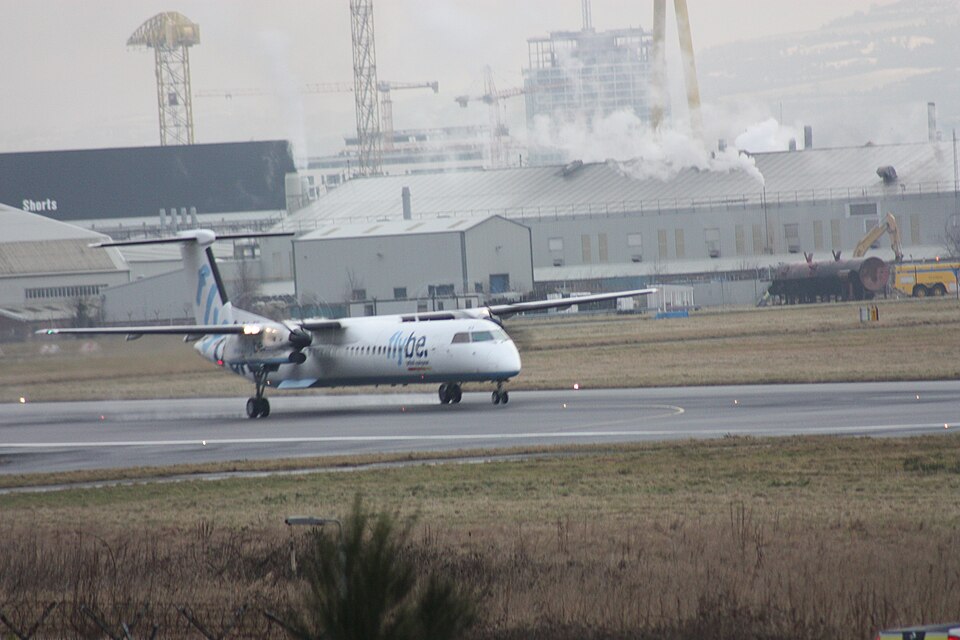
On 23 December 2008, at 1600 UTC, a De Havilland Canada DHC-8-402 Dash 8, registration G-JECI, was operating a scheduled passenger service from Southampton to Edinburgh (flight BEE247S). As the aircraft commenced its final approach to Runway 24 at Edinburgh Airport, the approach controller instructed the crew to turn onto a heading of 280° to intercept the ILS localiser, descend from 3,000 ft to 2,100 ft, and maintain a speed of at least 160 kt until 4 nm from touchdown. During the descent, the aircraft accelerated to approximately 200 kt with flaps and landing gear up. The aircraft did not level off at 2,100 ft but continued to descend at a constant vertical speed, remaining below the ILS glideslope.
At an altitude of approximately 1,800 ft, the approach controller instructed the pilots to contact the aerodrome controller. Around that time, Flap 5 was selected and the aircraft decelerated to about 180 kt. The ground movement controller, sitting beside the aerodrome controller in the visual control room, saw the aircraft approximately 5 nm from touchdown and noticed it appeared substantially below the glidepath. He mentioned this to the aerodrome controller. When the co-pilot called, the controller responded with a query about altitude. The co-pilot stated they would level now and that the glideslope capture had failed. The aircraft then climbed slightly and continued an apparently normal approach, landing without further incident.
Flight Director Control
The flight director on the Dash 8-402 provides lateral and vertical guidance displayed as a vertical and horizontal bar on each pilot's Primary Flight Display. It can be coupled to the autopilot for automatic control. Pilots manage the flight director and autopilot engagement using a Flight Guidance Control Panel and two buttons on each control wheel: a Tactile Control Steering pushbutton and an AP disengage switch. The status of the flight director is displayed on the Flight Mode Annunciator (FMA) at the top of each PFD. A mode is considered engaged only when indicated on the FMA, not just when the associated pushbutton has been pressed. Pilots must monitor the FMA in response to each selection.
Altitude Select Mode
In altitude select mode, the flight director provides commands to acquire and hold a selected altitude. Pilots must preselect an altitude, press the alt sel pushbutton to arm the mode, and manoeuvre the aircraft towards the altitude using a flight director vertical mode. When armed, 'alt sel' appears in white on the FMA. If not armed, the aircraft will continue through the selected altitude unless a pilot intervenes. With the autopilot engaged and without further inputs, as the aircraft approaches the selected altitude, the flight director changes to altitude capture mode (shown as 'alt*') and then to altitude hold mode ('alt'). If the altitude selection is changed to one above the current altitude before capture, the aircraft will continue descending in an 'open descent'.
ILS Approach Mode
The ILS approach mode captures and tracks both localiser and glideslope beams. To arm the mode, pilots press the APPR pushbutton after tuning the ILS frequency. When armed, 'gs' appears in white on the FMA. As the aircraft approaches the glideslope, the flight director changes to glideslope capture ('gs*') and then to glideslope track ('gs'). If the aircraft remains below the glideslope, capture does not occur and the aircraft continues in the active vertical mode.
Ground Proximity Warning System
The ground proximity warning system monitors flight path between 50 ft and 2,450 ft. Mode 5 provides a 'deviation below glideslope' alert when an ILS frequency is set, the landing gear is down, the aircraft is below 925 ft agl and below the glidepath, and the below g/s pushbutton is not pressed. It provides an aural 'glideslope' warning and illuminates an amber pushbutton. Below 300 ft agl, if deviation is 2 dots or more, a louder repetitive alert is given.
Recorded Information
Data from the Quick Access Recorder showed that the aircraft descended below the cleared altitude and glideslope. After ATC communication, the descent rate was reduced but the correct vertical path was not regained until later.
Safety Actions
Two Safety Recommendations were made by the AAIB. The operator and ATC unit have taken safety action aimed at preventing a recurrence. The aircraft manufacturer had proposed a modification to the flight director software so that selection of altitude select mode would be automatic upon selection of a new altitude, but implementation had been delayed.