History of the Flight
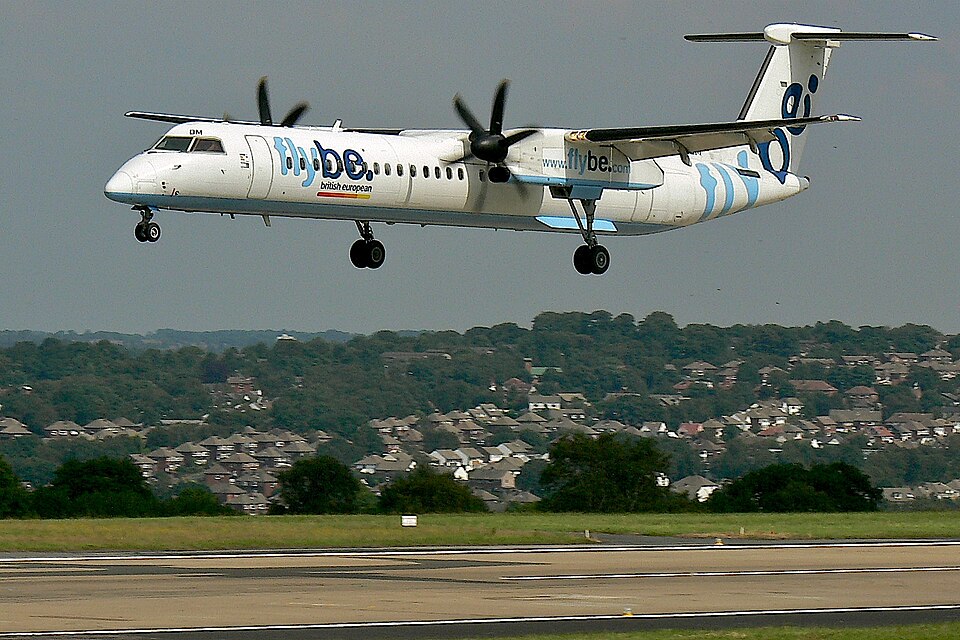
The aircraft, a DHC-8-402 Dash 8 (registration G-JEDM), was on a public transport passenger service from Newcastle to Exeter Airport. Approximately ten minutes before landing, while descending through cloud at 9,338 ft and an indicated airspeed of 260 kt, the aircraft experienced sudden and severe turbulence. The weather radar was selected to OFF. The autopilot disconnected automatically due to the severity of the turbulence. The commander, who was the handling pilot, kept the wings level and reduced power, then re-engaged the autopilot once the aircraft cleared the turbulence. The event lasted 15 seconds, during which the aircraft's speed reduced to 240 kt. The maximum recorded vertical acceleration was 2.285g.
In the cabin, the passengers were strapped into their seats in preparation for landing, but both cabin crew were on their feet. One cabin crew member managed to seat herself in a spare seat, while the other was standing in the galley at the rear of the cabin. He was twice lifted off his feet; on the second occasion, he fell heavily on his right ankle, coming to rest lying across the aircraft between the rear passenger exit and a service door. After the turbulence, other crew members provided first aid. Because he could not be moved to a seat, he was immobilised as much as possible. The aircraft landed without further incident, and emergency services transported the injured crew member to hospital, where his right ankle was diagnosed as broken. Subsequent engineering checks revealed no damage to the aircraft.
Meteorological Conditions
The Low Level forecast for the area below 10,000 ft, valid from 0800 to 1700 hrs on the day of the incident, predicted isolated scattered cumulus and stratocumulus cloud with moderate turbulence between 3,000 and 4,000 ft. Actual weather reports (METARs) from Exeter Airport at 1150 hrs indicated surface wind from 160° at 9 kt, visibility over 10 km, few clouds at 2,800 ft, temperature 22°C, dew point 15°C. At 1220 hrs, the surface wind was from 160° at 7 kt, visibility over 10 km, few clouds at 3,000 ft, temperature 23°C, dew point 14°C. The severe turbulence encountered was not forecast.
Procedures and Discussion
The operator's standard operating procedure (SOP) for severe turbulence, as stipulated in the operations manual, states: "On entering severe turbulence disengage the autopilot, maintain the desired pitch attitude and maintain wings level if possible… If severe turbulence is encountered unexpectedly, a slow acceleration/deceleration should be made to achieve the rough air speed." The aircraft's maximum permitted operating speed (VMO) below 10,000 ft is 282 kt; below 8,000 ft, VMO is 245 kt. The recommended speed for flight in turbulence is VMO - 10 kt, and 210 kt if the turbulence is severe. The SOP also required the seat belt sign to be switched on and passengers strapped into their seats ten minutes prior to landing. The commander had decided not to use the weather radar in the prevailing conditions. At the onset of turbulence, the airspeed was 50 kt faster than that recommended for severe turbulence. The encounter was unexpected. The autopilot disconnected automatically, and the airspeed was reduced during the turbulence as recommended. In accordance with SOPs, the passenger seat belt signs were on, and passengers were secured. The only persons not seated were the two cabin crew; one quickly found a seat, but the other did not and broke his ankle when he was lifted and fell heavily. It is likely that the aircraft would have experienced significant movement even at rough air speed, but the higher initial speed exacerbated the effects in the cabin.