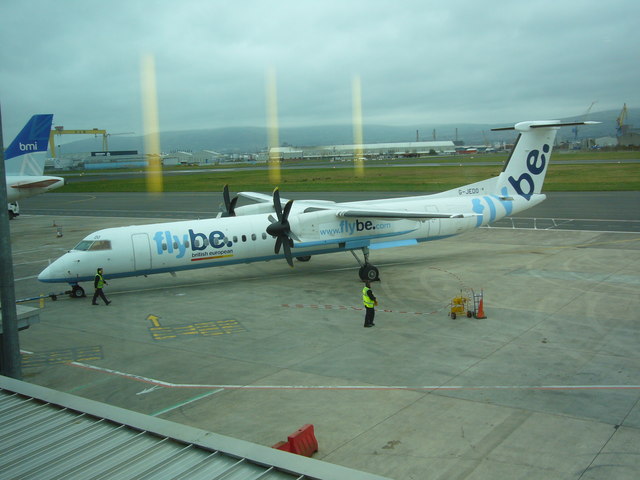
Incident Overview
On 3 March 2011, a DHC-8-402 Dash 8 (registration G-JEDR) operated a commercial passenger flight from Exeter Airport. During takeoff from Runway 08 at 1255 UTC, the flight crew heard a single "ding" audio signal between 80 kt and V1/VR. The co-pilot checked instruments but found no anomalies and reported it as spurious. After a positive rate of climb was established, the landing gear was selected up. As the gear retracted, the inboard wheel of the right main landing gear separated from its axle and fell within the airport boundary.
Flight Crew Actions
Shortly after takeoff, ATC informed the flight crew that the aircraft may have lost a wheel. The crew climbed to FL030 and entered a holding pattern east of Exeter. They reviewed the Abnormal and Emergency Checklists for landing gear malfunction and emergency landing. The commander contacted the Senior Cabin Crew Member (SCCM) to inspect the right landing gear area. The SCCM reported that the gear doors were closed but parts of the mechanism were protruding. A company engineer who was a passenger confirmed the observation.
The crew executed the Alternate Landing Gear Extension procedure. Initially, the right landing gear did not indicate movement, but after discussion with the engineer, it lowered and indicated down and locked. The crew then briefed for an emergency landing using a left-wing-down technique, with flaps at 35° and touchdown at or just below VREF of 112 kt. No wheel braking was used during the landing roll. The aircraft touched down on the left mainwheels first, then lowered the right mainwheel. The aircraft veered left, requiring significant right rudder to regain the centreline. After slowing, the commander applied the emergency brake, stopping the aircraft. The parking brake was set. Passengers disembarked via the front left door.
Flight Recorder Details
The aircraft was equipped with a flight data recorder (FDR) and cockpit voice recorder (CVR). FDR data was of limited use. The CVR had a two-hour recording duration, but the incident was overwritten by ground recordings after landing. Despite operator efforts to preserve recordings by instructing the crew to pull circuit breakers (CBs), the CVR continued recording until the aircraft was shut down 40 minutes later. The crew requested coordinates of the CBs but did not receive them.
Investigation Findings
Examination of the detached wheel and debris revealed that the wheel nut remained on the axle with locking devices correctly installed. The brake unit was loose and damaged. The axle had light scoring and minor flailing damage. The inboard main gear door showed contact with the rotating wheel assembly, and its rear hinge attachment was torn away.
The investigation focused on the wheel bearings. Each mainwheel has two taper roller bearings. The outer bearing had seized. This was most likely caused by the bearing cage and cup coming into contact due to excessive movement of the cage, probably due to wear. This led to catastrophic bearing failure, allowing the wheel to detach. Examination of seven recovered rollers showed minimal heat generation and wear. Two other wheel bearings from a recently overhauled mainwheel were found to have cage clearance due to cage wear that made them unserviceable; one showed signs of initial cage-to-cup contact. New bearings from stores had near maximum allowable clearance.
Safety Actions
Safety actions have been taken with the intention of preventing a recurrence.