Synopsis
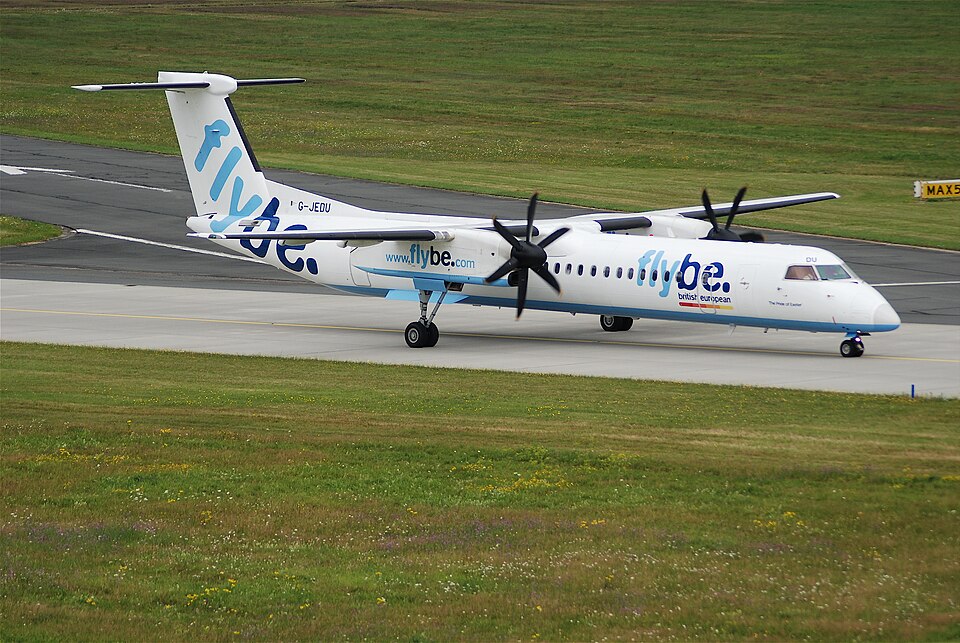
On 28 May 2008, a DHC-8-402 Dash 8, registration G-JEDU, operated a scheduled passenger flight from Exeter Airport, Devon, to Paris Charles de Gaulle Airport (CDG), France. The commander was line training the co-pilot, who was the handling pilot. During the final approach, the indicated airspeed (IAS) reduced below VREF at approximately 120 ft above aerodrome level (aal) without a significant power increase or intervention from the commander. The aircraft subsequently landed on its tail, 11 kt below VREF, causing damage to the rear underside of the fuselage. There were no injuries to the 4 crew or 37 passengers.
History of the Flight
The flight was uneventful until established on the ILS for Runway 27R at CDG. ATC instructed G-JEDU to maintain 180 kt until 4 nm. At 4 nm, the IAS was 173 kt and the power levers were reduced to flight idle. They remained at flight idle until 120 ft aal. At 500 ft, the IAS was approximately 136 kt (VREF +22 kt). At approximately 120 ft aal, with the aircraft fully configured with Flap 15, the IAS reduced below VREF. The commander said "SPEED APPEARS TO BE A BIT LOW". The co-pilot responded by increasing the power levers by approximately one percent of torque to 8%. The speed continued to decrease, and the aircraft landed on its tail at 103 kt (VREF – 11 kt), illuminating the RUNWAY TOUCHED warning. The commander did not intervene.
The aircraft vacated the runway, taxied onto stand, and passengers disembarked normally. The commander inspected the aircraft, discovered damage to the underside of the tail section, and reported the accident to ATC.
Commander's Comments
The commander stated that during the preceding week after his return to work, he did not feel unwell but was getting progressively more tired. He recalled thinking more power was required on the approach, to the extent that he thought he needed to apply the power himself, yet he did not react. He remembered a sense of "why am I not reacting to this" and being puzzled. He did not realize he was required to be grounded as a result of the accident and accepted a request to fly another aircraft back to Exeter.
Co-pilot's Comments
The co-pilot stated that she had only flown with the commander since his return to work after his illness and could not compare his manner during the accident flight to that of previous flights.
Operations Manual Compliance
The operator's Operations Manual Part B4 states that at every 100 ft below 500 ft aal, the non-handling pilot is to call out the speed unless it is between +5 kt and -0 kt of that to be flown. It also states that to achieve a stabilised approach, the speed must not exceed 160 kt inside 4 nm and that the IAS must not exceed VREF +15 kt at 500 ft radio altitude. At 500 ft, the pilot flying is to call '500 ft', to which the non-handling pilot is to respond with 'stable' or 'go-around'. The crew flew faster than 160 kt to 4 nm, the IAS was greater than VREF +15 kt at 500 ft, and the co-pilot did not call '500 ft'. The commander did not call out the speed every 100 ft below 500 ft.
Medical Background
The commander was admitted to hospital on 26 April 2008 and discharged 12 days later on 7 May 2008. On 12 May 2008, he contacted his General Practitioner, who signed him off as sick until 18 May 2008. He also informed his Aviation Medical Examiner (AME) about his hospitalisation. The AME advised that as he had finished his course of medication and it had been less than 21 days since the start of the illness, he could return to work when he felt fit and no medical examination would be required. The commander returned to work on 19 May 2008, 23 days after being admitted to hospital. After his return, he worked three days, followed by two days off, then five days on; the accident occurred on the fifth day.
Post-accident Actions
The commander attempted to contact the operator's Flight Safety Manager and Fleet Manager but the accident occurred outside normal working hours. He contacted the operator's logistics department and discussed the accident with the duty manager, who asked him to operate another aircraft back to Exeter as part of the recovery programme; the commander accepted. Subsequently, the co-pilot undertook simulator training before continuing her line training. All the operator's logistics and engineering staff were trained on the definition of an accident and serious incident and post-accident procedures. Following this accident, the CAA's Aeromedical section sent a notice to all AMEs regarding advice for return to work after illness.